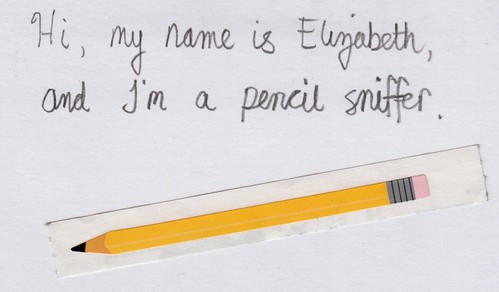
But I can stop any time I want.


As has been well established within the pages of this blog, I am something of a notebook addict. I have scads of notebooks squirreled away: mostly cheap composition books, but also a second Rhodia Webnotebook (I used my first awhile back), an empty Moleskine, a hard bound Rite in the Rain notebook, a cloth-bound Clairefontaine, a Leuchtturm1917, and a hardcover Blueline, among others. Pretty much every time I finish a notebook, I take these nicer journals and notebooks off the shelf and finger them...and then ultimately put them back and grab one of the ubiquitous composition books.
It's not so much that I'm intimidated by them, I don't think. I've never been one to worry about ruining that first page with less-than-profound thoughts and messy handwriting. I think it's more that right now, they're mine as objects to be treasured (and gloated over). Once used, the notebooks themselves no longer matter--only the words inside matter. The notebooks fade into the background and become just another repository for my scribbles.
 >
>
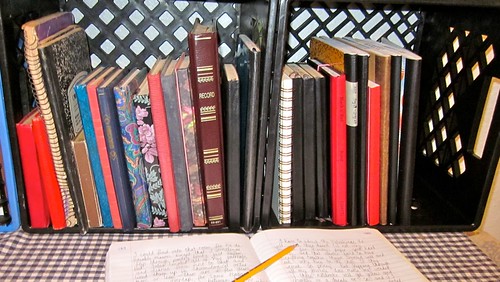
Some past notebooks, which I wrote about here.
I have a strange mental block against letting them go. Which, I suppose, is something of a hoarder mentality, and probably not very healthy.
I think I shall resolve to live more openly (recklessly?) and to embrace what my hoarded goods may become, even if it means letting go of what they are now. What have I got to lose?
Except for those lovely empty notebooks...
Oh dear.

Not to mention "its" from "it's" and "to" from "too" and (particularly onerous) "loose" from "lose." I'd also like to require remedial education for those who insist on putting random apostrophes in plural words: "kid's" instead of "kids," for example.
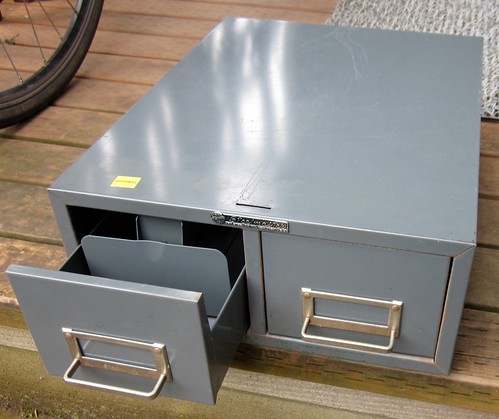
Now *that* is an index card cabinet. I don't exactly have enough cards to fill it yet, but really, for eight dollars, could I resist? Of course not.
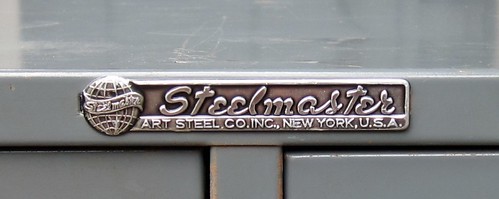
Steelmaster's logo is pretty retro-cool! I'm not sure this is actually vintage, since Steelmaster still appears to be making filing cabinets, but the styling is classic.
And I particularly like these little spring-loaded slidey thingies. They allow for easy expansion.

It stacks nicely, and will hold some of my smallish notebooks as well as index cards.
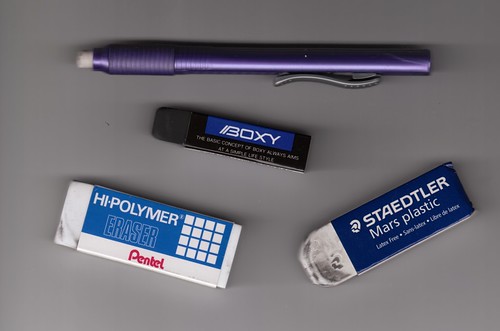
(Yes, seriously, a post about erasers).
NEWS FLASH: Pentel Hi-Polymer Erasers are TEH AWESOME.
1. When I first encountered the Mars Plastic Eraser a few years ago, it was a revelation. An eraser that actually...well, erased? And did so without leaving smeary crumbs like ye olde gritty pink erasers of yore? Whoa. There's a reason these are one of the benchmarks of eraserdom.
Since my eyes were opened to the possibilities, I've picked up a few other eraser varieties.
2. The Papermate Black Pearl (out sick the day the class photo was taken) is a great shape--if you use a sharp edge, you can get into pretty small spaces, but used lengthwise you can go to *town* with the thing. And being black, it doesn't acquire the grungy...um...patina of the white erasers. It does, however, produce more and messier residue than the Mars.
3. The Pentel Clic erasers get into small spaces and erase almost entirely--I think they're the same material as my new favorite eraser, actually. For things like math problems where you might need to erase one tiny character at a time, I imagine these'd be the way to go. Because they retract, they also can be kept pretty neat and clean--I keep one in my purse partly for this reason. But I like the solid, stolid simplicity of plain old block erasers, and (how shall I put this?) the way these sort of squish when you press down on them unnerves me.
4. Awhile back I picked up a Uni-ball "Boxy" eraser on a whim when placing a Jet Pens order, and this may be *the* primo eraser. Black, so it doesn't show graphite, and as you erase, the little shreds roll into a sticky little ball all by themselves, so they're very tidy. They also have that somewhat enigmatic little slogan: "The basic concept of Boxy always aims at a simple life style." Mmkay. Good to ponder. And, most importantly, wow they work well, even on dark and smeary pencil. They are, however, small, difficult to find, and rather expensive as erasers go. Also they are soft enough to damage by hard use if you aren't careful.
5. But the Pentel Hi-Polymer ZEH10 may be the Baby Bear's Chair of graphite erasers. Not only do they have a nifty '80s sort of style goin' on with the print on their little sleeve thingie, they're also large, long lasting, and work pretty much like the Boxy but are less easy to damage. As a bonus, they're available lots of places. I bought three of these bad boys for less than two bucks at Wal-Mart. I'm sold.
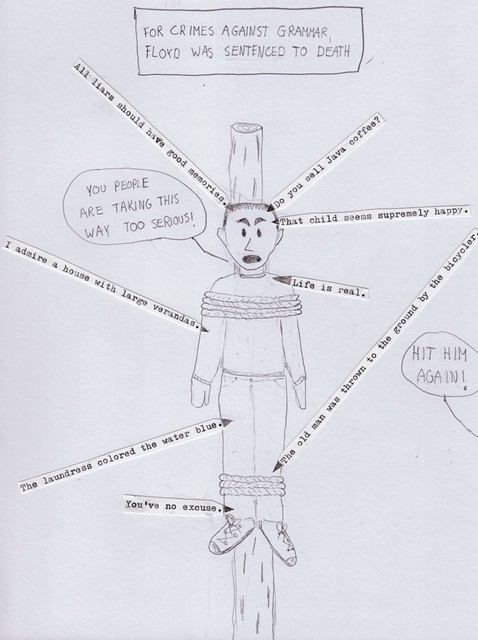
The sentences are examples taken from old grammar text books, because the idea of doing so amused me.
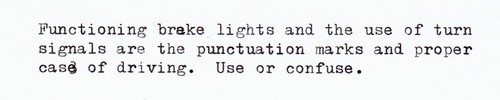
Without them, we can't quite be sure if you're starting or stopping or slowing down, or quite where you're going.
When I was a kid, back in the dark days before Encarta and Wikipedia and all that, we had a couple of sets of encyclopedias. They were great sources of knowledge, as well as interesting snapshots of a given period in time--one set dated from the 60s, another was slightly more recent, though still out of date, so the science items in particular were occasionally unintentionally comical. (You can imagine the example photos they had in the article about "Computer," for example...)
My brother John and I spent many a rainy day or winter evening with those books, either tracing themes from one volume to another, or just reading straight through. Sometimes I'd take a volume to bed with me and fall asleep reading about aardvarks and Albania and the Appalachian Trail. I also liked studying the very first page of those volumes, where they discussed the history of whatever-letter-it-was.
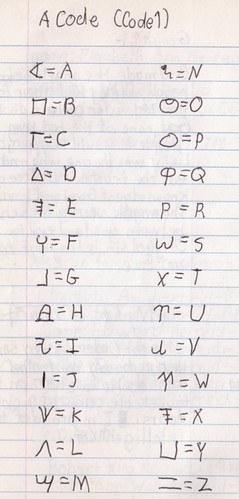
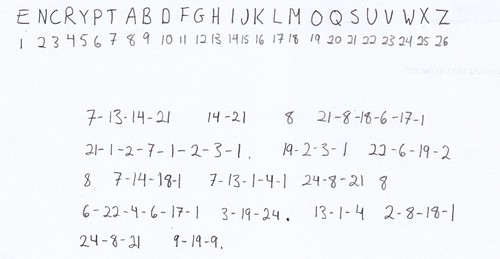
Now...like most kids, we were also captivated by secret codes. Who wasn't? We came up with various forms of encryption, like the old standard of using a key word to come up with a 26 number alphabet code. Remember that? Basically, you'd pick a random word with no repeated letters, write that out, followed by the remaining letters of the alphabet, and write the numbers 1 through 26 by them. Unless the recipient knew the keyword, it was hard to figure out which numbers meant what.
But like I said, I also found those historical predecessors to the current alphabet very interesting, and somewhere along the line, we hit upon the idea of using those to make a simple to use and intuitive "code" to use amongst ourselves. It was pretty easy to break, but easy to memorize and fun. Some letters had common predecessors or no very interesting variations, so we had to make up a few letter shapes, but most came straight from older forms. I kept journal entries in code some of the time back then, and even as an older teenager away from home used to write letters to my brother using these letters. Kinda fun.
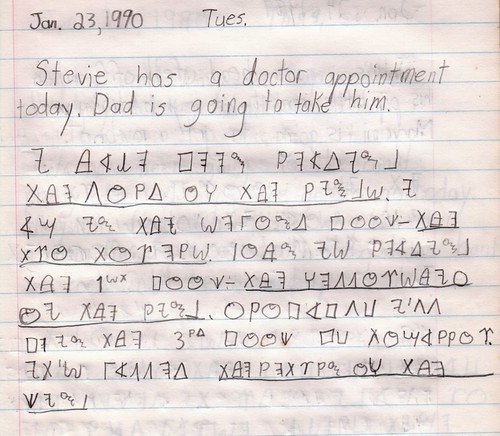
I used to write portions of my journal entry in code, even if it wasn't really anything secretive...
What sort of codes have you played around with? What did you use them for, and with whom?
Only now I discover that true Tweets are actually limited to 140 characters *including* spaces...something I didn't know since I've never really done the true type of Twitter. I'll attempt further brevity in future.


