For various reasons, I've found myself returning to some old posts, reviews, and thoughts, and I thought it might be fun to do a little recap post.
1. Remember this leather composition book cover I was so excited about? I'm still thrilled with it. For the last little bit I've mostly used it as a cover for my journal, since I keep coming back to using cheap composition books as journals--fancy notebooks intimidate me, I guess. The cord has held up well, the leather still feels and smells great and if anything has become more beautiful with time. I look forward to using it for years to come. Have any drawbacks arisen? One minor one, I suppose: it left what look like slightly oily spots on the inside cover of a few of the first notebooks that passed through it, maybe from the adhesive used where the edges fold under? A small price to pay for the use of that lovely leather, I'd say, but possibly a concern.
2. The Classroom Friendly Pencil Sharpener: a few months in, I'm still pretty psyched about this thing. I love the point it produces and the way it stops when a point is reached. No additional downsides have arisen since my initial review, but just to reiterate the two that I encountered: first and foremost, the gripping mechanism leaves little bite marks on the pencil, which may or may not bother you. Some days it bothers me more than others. Secondly, though this isn't really a fault of the sharpener and can happen with other sharpeners as well, if the pencil lead is off-center, the sharpener won't automatically stop sharpening after a point is reached...because the point will be lopsided and still sort of catch the mechanism. Just something to be aware of--if you run into a pencil that has this issue, just turn the crank a few times when sharpening and then stop.
3. Index cards: I admit, for story ideas, quick notes, poems, etc., I've mostly returned to using the small notebook I carry everywhere. Why? Because even though it's cluttered and jumbled and can't be reorganized, it's all in one place, bound together so it can't be lost unless I lose the whole thing (an idea so scary I refuse to let it fully take shape in my mind). I like being able to flip through it when I'm looking for inspiration, and not having to search for a card I used last week. I still use index cards a lot for to-dos, lists, addresses, etc., so they are always with me...but not as I had envisioned. I tried to use them for story outlining a few more times, and again found that no matter how much or how little detail I tried to include, once I started writing the story, the story veered away from any outline. Maybe this dooms me as a writer, I don't know. I have stacks of scene cards and character sketches that meant nothing four or five pages into the actual writing. Will this prevent me from trying again to plan ahead? Of course not. There's a fine line between an eternal optimist and a fool, and I walk that line.
4. My use of Circa things has also undergone some revision. I use Circa for my work notebooks quite a bit, since I like being able to move pages around and like that I can reuse scrap paper by just Circa punching it. I still use it some for binding typewritten pages, too: one of these days I'm going to put all my old typecasts into a Circa notebook, I think, since I can easily mix all the different sizes of pages I use for typecasts--not something I could do with a three-ring binder. But for everyday scribbling-in-a-notebook use, I keep coming back to the composition books. No, I can't reorganize the pages, which means I have page number references and arrows everywhere as I try to make sense of the jumble. But I like the size, the sturdiness, and they soothe my paranoia about pages going missing. And they're just so doggone cheap and friendly.
5. Yesterday I stumbled across a post I wrote about a lumberjack throw I made for my first little nephew, who's now...um...three. Actually had to check the date of the post to remember. Time flies when you're having fun! I had every intention of making several more of these in different color combinations for other family members, since they look pretty cool, work up pretty fast, and aren't too terribly difficult to do (I'm not exactly a master of crochet). I bought at least some of the yarn...but never started. Story of my life. Last night I decided to take the first step toward remedying this situation, and finished the first few rows of a second throw, which will use a slightly darker red. Crocheting is soothing--the rhythm of stitching, the feel of the yarn as it moves through your fingers, the way the piece slowly grows in your hands. Nice to come back to that.

Showing posts with label Circa. Show all posts
Showing posts with label Circa. Show all posts
Thursday, March 10, 2011


Wednesday, July 01, 2009
Index Card Circa Hack
I've started using the typewriters again heavily, after several months of mostly writing by hand. As a result, I'm using the Circa/Rollabind notebooks again quite a bit. I like that I can put all my typewritten pages in a notebook for easy perusal, and with the knowledge that if one morning I get up and decide to hit the coffee house and write by hand for awhile, I can do that in the same notebook.
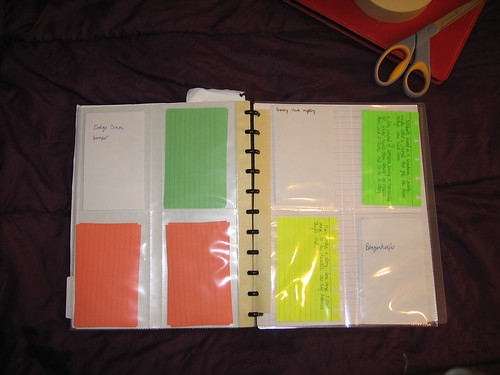
In anticipation of November and for my own use now, I wanted a way to store/display index cards in the notebook. The ideal solution would probably be some of Levenger's Dock-it pages, but I'm on a Levenger fast for the time being, and nice as they are, I'm still not sure they're worth the amount it'd cost me to get them, especially with Levenger's high shipping costs factored in. Instead, I came up with this solution.
At Office Depot, I picked up a package of 3-ring binder inserts intended for 3 x 5" photos. They only have four pockets on a page, and only on one side (Levenger's obviously have considerably more, and are far heavier in weight), but cards can face backwards since the page is clear on both sides. Each pocket can hold a decent sized stack of cards.
I trimmed off the side tab with the three holes, reinforced the section next to that with masking tape, and Circa punched. I also had to trim the top of the page a little bit so it wouldn't stick out.
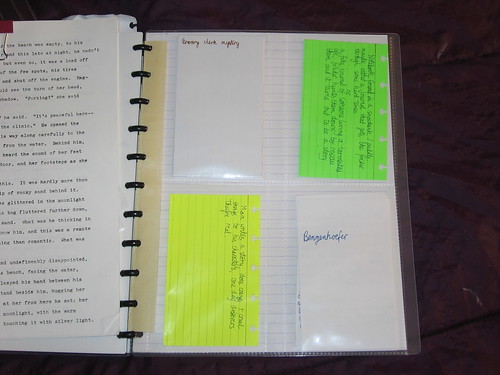
The final result: it works pretty well! I'm proud of myself. And a package of ten pages is under three dollars at Office Depot, for a total of 80 visible pockets, with space for far more cards than are immediately visible. More than likely I'll only add one or two of these to each notebook, and use them primarily for storage of cards related to the story I'm currently working on--character sketches, items and events to remember to include, maps, etc. So long as I can see the top card in each stack, I'm good.
One more view:
In other news, I'm most of the way through the first draft of Yet Another Short Story, and Stinky and I dashed down the first few paragraphs of the one after that this evening. Hey, if you're gonna write smoky bar scenes, Stinky is the typewriter to go to. He's had a hard life, and he knows his way around.
In anticipation of November and for my own use now, I wanted a way to store/display index cards in the notebook. The ideal solution would probably be some of Levenger's Dock-it pages, but I'm on a Levenger fast for the time being, and nice as they are, I'm still not sure they're worth the amount it'd cost me to get them, especially with Levenger's high shipping costs factored in. Instead, I came up with this solution.
At Office Depot, I picked up a package of 3-ring binder inserts intended for 3 x 5" photos. They only have four pockets on a page, and only on one side (Levenger's obviously have considerably more, and are far heavier in weight), but cards can face backwards since the page is clear on both sides. Each pocket can hold a decent sized stack of cards.
I trimmed off the side tab with the three holes, reinforced the section next to that with masking tape, and Circa punched. I also had to trim the top of the page a little bit so it wouldn't stick out.
The final result: it works pretty well! I'm proud of myself. And a package of ten pages is under three dollars at Office Depot, for a total of 80 visible pockets, with space for far more cards than are immediately visible. More than likely I'll only add one or two of these to each notebook, and use them primarily for storage of cards related to the story I'm currently working on--character sketches, items and events to remember to include, maps, etc. So long as I can see the top card in each stack, I'm good.
One more view:
In other news, I'm most of the way through the first draft of Yet Another Short Story, and Stinky and I dashed down the first few paragraphs of the one after that this evening. Hey, if you're gonna write smoky bar scenes, Stinky is the typewriter to go to. He's had a hard life, and he knows his way around.
Friday, May 08, 2009
Regularly irregular musings
So...how are the typecasting journal entries coming along? I'm just about done with the final draft of the story I *may* be submitting. It's a short short, I think. The terminology for short stories is all new to me. This is uncharted territory: well out of my comfort zone.
I'm one of those people who's never had a serious problem finishing NaNoWriMo. No, it isn't easy, but if I force myself to sit down and put one word in front of another for a few hours every day, I can do it. I'm not one of those crazy people who can sit and pound out 4000 words in a sitting (had a roommate during one NaNo who was, and it annoyed the snot out of me, I admit) but I can write a decent number of words steadily day after day. And my stories usually start out much too wordy and then gets whittled down. If brevity is the soul of wit, my wit (such as it is) is some sort of soulless wraith.
As a result, this story has been an incredible challenge for me. It's the anti-NaNo: saying as much as possible in the fewest possible words; implying details and descriptions some of the time rather than sketching them out, leaving most of the color and scenery and background to the imagination of the reader. In a thousand words, you can't do much more than capture a single snapshot in your characters' lives, or the borders and boldest lines. I'm not good at it. It makes me cranky. Therefore, this is probably good for me.
And speaking of difficult-but-potentially-good-for-me activities, is anyone else semi-terrified by the concept of revealing a fictional work to even a small subset of the big wide world? I sure am. For one thing, I always worry that my stories are, as a high school English teacher once put it to me, too "bleeding heart." But it's more than that. Fiction is an entirely different animal than non-fiction. Why is that? (Rhetorical question.)
In one of my notebooks, I came across something I had written to the effect that nonfiction reveals one's thoughts and opinions; fiction one's heart and soul. I'm not sure I really believe that--I think I just liked the way it sounded when I wrote it down. But why *are* we more self-conscious about make-believe? Or am I the only one who feels this way?
On another subject, I read with interest the pocket briefcase vs pocket Moleskine throw-down Strikethru linked to here. My International Pocket Briefcase arrived a few days ago, courtesy of the Levenger outlet on eBay. It was cheaper than the Franklin Covey version I posted about here, once I factored in local tax (right about $16). Pretty cool.
Since it's larger than the shirt pocket briefcase listed in the review, it's not quite as direct a comparison--I'm using it as a wallet as well as a notepad. But the Moleskine has been my carry-everywhere writing surface up to now, so the comparison is there. Since I'm a gal and rarely have a pocket that would hold either one, the size differences aren't as crucial. It comes down to the format differences. On the one hand, the notebook means you carry everything you've written around with you, so you always have it. On the other hand, the cards let you carry just the important stuff, toss the grocery lists and memos, and organize into categories at home. It's more flexible, but less contained. It's my Circa vs composition book dilemma in miniature, and time will tell how I feel about it. I foresee still using the Moleskine for longer entries.
As for the wallet itself, it is marvelously soft but sturdy feeling leather--smells wonderful. There's a little more wiggle-room for the cards than there was in the cheaper one, which I'm very grateful for--makes it much easier to get them in and out, and the writing surface will hold about three or four cards in a stack without complaining. The wallet side where there's space for cash and receipts has a shallower little area for paper money, instead of just being a deep gaping pocket where narrower items get lost. All in all, a step up, and I think I can live with the fake initials....
I'm one of those people who's never had a serious problem finishing NaNoWriMo. No, it isn't easy, but if I force myself to sit down and put one word in front of another for a few hours every day, I can do it. I'm not one of those crazy people who can sit and pound out 4000 words in a sitting (had a roommate during one NaNo who was, and it annoyed the snot out of me, I admit) but I can write a decent number of words steadily day after day. And my stories usually start out much too wordy and then gets whittled down. If brevity is the soul of wit, my wit (such as it is) is some sort of soulless wraith.
As a result, this story has been an incredible challenge for me. It's the anti-NaNo: saying as much as possible in the fewest possible words; implying details and descriptions some of the time rather than sketching them out, leaving most of the color and scenery and background to the imagination of the reader. In a thousand words, you can't do much more than capture a single snapshot in your characters' lives, or the borders and boldest lines. I'm not good at it. It makes me cranky. Therefore, this is probably good for me.
And speaking of difficult-but-potentially-good-for-me activities, is anyone else semi-terrified by the concept of revealing a fictional work to even a small subset of the big wide world? I sure am. For one thing, I always worry that my stories are, as a high school English teacher once put it to me, too "bleeding heart." But it's more than that. Fiction is an entirely different animal than non-fiction. Why is that? (Rhetorical question.)
In one of my notebooks, I came across something I had written to the effect that nonfiction reveals one's thoughts and opinions; fiction one's heart and soul. I'm not sure I really believe that--I think I just liked the way it sounded when I wrote it down. But why *are* we more self-conscious about make-believe? Or am I the only one who feels this way?
On another subject, I read with interest the pocket briefcase vs pocket Moleskine throw-down Strikethru linked to here. My International Pocket Briefcase arrived a few days ago, courtesy of the Levenger outlet on eBay. It was cheaper than the Franklin Covey version I posted about here, once I factored in local tax (right about $16). Pretty cool.
Since it's larger than the shirt pocket briefcase listed in the review, it's not quite as direct a comparison--I'm using it as a wallet as well as a notepad. But the Moleskine has been my carry-everywhere writing surface up to now, so the comparison is there. Since I'm a gal and rarely have a pocket that would hold either one, the size differences aren't as crucial. It comes down to the format differences. On the one hand, the notebook means you carry everything you've written around with you, so you always have it. On the other hand, the cards let you carry just the important stuff, toss the grocery lists and memos, and organize into categories at home. It's more flexible, but less contained. It's my Circa vs composition book dilemma in miniature, and time will tell how I feel about it. I foresee still using the Moleskine for longer entries.
As for the wallet itself, it is marvelously soft but sturdy feeling leather--smells wonderful. There's a little more wiggle-room for the cards than there was in the cheaper one, which I'm very grateful for--makes it much easier to get them in and out, and the writing surface will hold about three or four cards in a stack without complaining. The wallet side where there's space for cash and receipts has a shallower little area for paper money, instead of just being a deep gaping pocket where narrower items get lost. All in all, a step up, and I think I can live with the fake initials....
Saturday, April 18, 2009
Random heretical thoughts, plus more backsliding
I am something of a retrogrouch. Big surprise there. I've gone on record saying that electronic books will never catch on (for me, in any case), that ink and paper is still the best way to record thought, that I can't imagine why anyone would rely on devices that require power.
But this week, I've had to eat my words, somewhat, not once but twice.
First of all, I got to play with a Kindle 2 that some friends recently received, and I have to say, that is one cool little device. I was shocked, for starters, that it looks like...well...ink on paper. It's a far cry from reading text on a backlit PDA type of device. It's easy on the eyes and has the contrast, pretty much, of regular paper, BUT it lies perfectly flat, you can resize the text if you wish, the pages turn at the press of a button, you can easily jump to any given page, search for words...it's almost the best of both worlds. Not that I'm ready to drop $350 on one, but I'm still impressed. Especially considering all the free books available on sites like Gutenberg.org. (I WUVVVV Gutenberg.org!!!) I'd still have worries about battery life, and the fact that any device like that can malfunction and cut you off from your reading material, and that technology changes while printed written material will still be readable without a special device for lifetimes. But I admit, I can see these digital thingies having a place in the world. I'd never give up my real books, but it'd be nice to be able to carry *all* your favorite books and all your favorite reference books on a trip in a two pound package, ya know?
The second instance of anti-Luddite "oooh, cool technology!" I experienced this week was in reaction to a Livescribe pen one of my coworkers picked up. This is one nifty little gadget. It works like a regular ball point pen, but as you write on special dot matrix paper (but it *is* paper!) it records your pen strokes. You can simultaneously record the audio of whatever you're taking notes on, and can later tap that section to hear the audio that was occurring as you were writing. It lets you save your handwritten notes in image form (there are add-ons that are supposed to do handwriting recognition, but I have no idea how well those work), and again, you can search for keywords. I don't know how it identifies the words within regular handwriting, but it seems to be pretty accurate. Magic. And, of course, you still have your handwritten notes to refer to should everything crash.
You can also print pages with the dot matrix grid on regular paper, which makes my Circa/Rolla-loving self twittery. It requires a color laser, though, so it may not be practical for most.
I think the Livescribe is still new enough that there are kinks to work out, but I'm fascinated by this melding of technology with reg'lar old writing on paper. It pleases me. I think it's a far more realistic and practical approach to sci-fi-like technology than a complete movement away from paper and pens and other manual ways of getting data down.
No financial involvement in either of these toys...I can't afford 'em. ;-) But I reluctantly admit that they're pretty darned cool.
As for myself, I'm still quite happy with pen and paper for most purposes. I do a ton of taking notes and making hand-written to-do lists at work: things stick in my head better that way. I go through a lot of notebooks (usually steno pads) and save old ones so I can refer back. I also tend to scribble down to-do lists or notes or poems or other writing for home in the midst of everything and tear them out, leaving me with raggedy steno pages all over the house, tucked into my home notebooks and journal, and in the pockets of my bag.
I'm about to finish another pad at work, after which I'm experimentally going Rollabind for a bit. It will mean I can stick pages from my work notebook into my home one without a problem, and also I can pick my own paper (woo-hoo!): something that will work with fountain pens if I wish--and unlined, which I've come to prefer most of the time. I like the smaller Junior sized for at work since it takes up less real estate on the desk, so today I bought a Rollabind notebook at Staples for five bucks (yes, expensive for a notebook...but it's a reuseable cover), and a ream of good paper. I took the paper to Kinkos and had them cut it in half to fit the cover nicely. It only cost about a buck fifty for the cut, so it was worth it. I now have a thousand pages worth of notebook paper--should be enough to last me for at least a coupla years.... The paper is actually a little too big for the cover (I think Levenger's covers are a little longer, but I could be wrong), but since this will mostly live on a desk, and I just need the cover as an occasional hard surface to write on when I'm taking notes without a table, I can live with the imperfection.
Mmm...paper....
But this week, I've had to eat my words, somewhat, not once but twice.
First of all, I got to play with a Kindle 2 that some friends recently received, and I have to say, that is one cool little device. I was shocked, for starters, that it looks like...well...ink on paper. It's a far cry from reading text on a backlit PDA type of device. It's easy on the eyes and has the contrast, pretty much, of regular paper, BUT it lies perfectly flat, you can resize the text if you wish, the pages turn at the press of a button, you can easily jump to any given page, search for words...it's almost the best of both worlds. Not that I'm ready to drop $350 on one, but I'm still impressed. Especially considering all the free books available on sites like Gutenberg.org. (I WUVVVV Gutenberg.org!!!) I'd still have worries about battery life, and the fact that any device like that can malfunction and cut you off from your reading material, and that technology changes while printed written material will still be readable without a special device for lifetimes. But I admit, I can see these digital thingies having a place in the world. I'd never give up my real books, but it'd be nice to be able to carry *all* your favorite books and all your favorite reference books on a trip in a two pound package, ya know?
The second instance of anti-Luddite "oooh, cool technology!" I experienced this week was in reaction to a Livescribe pen one of my coworkers picked up. This is one nifty little gadget. It works like a regular ball point pen, but as you write on special dot matrix paper (but it *is* paper!) it records your pen strokes. You can simultaneously record the audio of whatever you're taking notes on, and can later tap that section to hear the audio that was occurring as you were writing. It lets you save your handwritten notes in image form (there are add-ons that are supposed to do handwriting recognition, but I have no idea how well those work), and again, you can search for keywords. I don't know how it identifies the words within regular handwriting, but it seems to be pretty accurate. Magic. And, of course, you still have your handwritten notes to refer to should everything crash.
You can also print pages with the dot matrix grid on regular paper, which makes my Circa/Rolla-loving self twittery. It requires a color laser, though, so it may not be practical for most.
I think the Livescribe is still new enough that there are kinks to work out, but I'm fascinated by this melding of technology with reg'lar old writing on paper. It pleases me. I think it's a far more realistic and practical approach to sci-fi-like technology than a complete movement away from paper and pens and other manual ways of getting data down.
No financial involvement in either of these toys...I can't afford 'em. ;-) But I reluctantly admit that they're pretty darned cool.
As for myself, I'm still quite happy with pen and paper for most purposes. I do a ton of taking notes and making hand-written to-do lists at work: things stick in my head better that way. I go through a lot of notebooks (usually steno pads) and save old ones so I can refer back. I also tend to scribble down to-do lists or notes or poems or other writing for home in the midst of everything and tear them out, leaving me with raggedy steno pages all over the house, tucked into my home notebooks and journal, and in the pockets of my bag.
I'm about to finish another pad at work, after which I'm experimentally going Rollabind for a bit. It will mean I can stick pages from my work notebook into my home one without a problem, and also I can pick my own paper (woo-hoo!): something that will work with fountain pens if I wish--and unlined, which I've come to prefer most of the time. I like the smaller Junior sized for at work since it takes up less real estate on the desk, so today I bought a Rollabind notebook at Staples for five bucks (yes, expensive for a notebook...but it's a reuseable cover), and a ream of good paper. I took the paper to Kinkos and had them cut it in half to fit the cover nicely. It only cost about a buck fifty for the cut, so it was worth it. I now have a thousand pages worth of notebook paper--should be enough to last me for at least a coupla years.... The paper is actually a little too big for the cover (I think Levenger's covers are a little longer, but I could be wrong), but since this will mostly live on a desk, and I just need the cover as an occasional hard surface to write on when I'm taking notes without a table, I can live with the imperfection.
Mmm...paper....
Tuesday, December 02, 2008
NaNoWriMo Redux, and paper and stuff
1. NaNoWriMo Redux:
Another year of NaNoWriMo insanity has come and gone, and I managed to squeak past the finish line for the sixth time. Yay, me! This was the second time I've handwritten it with fountain pens start to finish, in spite of my good intentions on the typewriter front. I don't exactly understand my own reasoning there. Part of it was that I'd started out by hand, figured out my average page count, and it was easier to stick with the figuring if I didn't switch methods. Partly I just liked (some of) the results I was getting. Partly I once again got all obsessed with fountain pens and ink, and I tend to focus on one obsession at a time. And I also got into the habit of hitting the coffee house at six thirty or seven every morning and writing for a solid hour before heading off to work. I'm still not at a point where I'm comfy lugging a typewriter into a very quiet early morning coffee house to type.
In any case, I finished. What have I learned? What did I come away with? Well, for the third year in a row, I have a story I think merits finishing and polishing. It needs considerable rewriting, but my stories always do. I'm a figure-it-out-as-I-go writer, and sometimes my stories are a bit like a game of telephone. I have to go back to the beginning and rewrite the scenes that I understand better now that the characters have fully evolved. But the story is moving. I have a head start; I've slogged through the sometimes tedious and scary initial stages of inventing characters and scenes and figuring out the skeleton of the plot. I love that about NaNo. I still have a good half the story to write, and a lot to trim away. I can't really blame NaNo for the bits that need trimming. It's more to do with my own tendencies as a writer: if I get stuck, I spin my wheels, and the story takes awhile to move on. Much of the wheel spinning will need to come out in the rewrite, but without it, I never hit the ground and move forward. Honestly, this is another reason paper works for me. I need to see all of those stages where I'm trying to figure out where to go or how to say something important. On paper, my character may say the same thing four different ways, and of course that's redundant. But now I can come back when the story is done--after I know *exactly* who that character is--and choose which of the four ways is really, truly them. I love that.
OK, now for some negativity. You know that old adage about monkeys on typewriters? Well, you know and I know it's a bunch of hooey. It doesn't matter how much time you give the monkeys, they'll never pound out anything but gibberish. Sometimes I feel like one of those monkeys. There are lots of inspirational little sayings out there about needing to write so many words of dross before being able to write a really good novel. But the truth is, you do need a certain amount of innate talent and creativity, or you're basically like one of those monkeys: no amount of time and effort and books and classes and critiquing is going to change the fact that there's a limit to just how good you're gonna get. Skills can only be honed within one's limitations. I tell myself that it doesn't matter, because I'm only writing for myself, but--and many of you can identify with this, I think--there's a little part of me that still wishes--at least some of the time, or now and again--that I could be that big famous author I dreamed of being when I was first learning to form sentences on paper. And there's still that little voice that says writing isn't worth it unless I am capable of doing just that, but I'm not, so why do I try? No matter how many times I tell that little voice to scram, it still pops up now and again to ridicule me and tell me that what I'm doing is pointless and painful and will only mean I leave piles of paper for people to laugh at when I'm gone.
Wretched thoughts. But can anyone identify sometimes, at least a little bit? I've been plotting ways to kill the little voice, but it tells me my ways aren't nearly creative enough. Poisoning with an antifreeze smoothie has been done. Shooting is soooo messy and overused. Dissolving with acid tends to muck up the carpeting if you drip....
2. Paper and stuff
Thanks to the guidance of fellow typecaster mpclemens and a 20%-off coupon I found on DIY Planner, I picked up some Circa/Rollabind disc-binding goods right before NaNoWriMo began. My entire 50,000 words fit into one letter-sized Circa notebook, on lovely fountain-pen-friendly heavy HP laser paper that I punched to fit. I also punched 3x5 cards to add notes in various places, especially questions and comments for the rewrite; added articles that I wanted to references; moved pages around or took 'em out as needed. It's a perfect system for a writer. You can combine typed pages, handwritten pages, reference material, pages of different sizes and shapes...all in one notebook that holds together nicely. I was impressed with how well it worked for me.
So, naturally, during the month I went to Wal-mart (during an hour when no one was there...) and picked up a stack of my old favorites: el-cheapo composition books (the Made in Brazil ones with nicer paper). This is my logic for you. Especially considering that the Circa stuff is a pretty hefty investment.
Not that composition books don't have their points, for sure. One thing that concerns me a bit about the Circa books is that you *can* move things around. It's not like anything fell out in spite of all the flipping through the book I did over the course of the month. It seems less likely to come apart than the average spiral book, honestly, especially if you use heavyish paper. But it's still an irrational fear of mine. I've never had a comp book tear in all my over twenty years or so of using them. And they're the perfect size. And they're cheap. And I am immediately comfortable with scribbling in the margins and drawing doodles at the top of the page and writing all my hard to spell words inside the covers, etc., etc. They're a well known and loved quantity.
But I can't mix them with typing or easily add any other information to them, and therein lies the rub. I usually just combine them with a smaller notebook for any notes that don't fit in the margins (since I number the pages, I can even mark what comp book and what page the notes apply to), but it's not quite the same as having one package. I like 'em both. I'll probably use both. I'm using a composition notebook for the next section of the story, for example, if only because I felt guilty about having 'em otherwise. But I struggle with the inconsistency of it all.
I'm fortunate that these are the complex issues of my life right now....
Another year of NaNoWriMo insanity has come and gone, and I managed to squeak past the finish line for the sixth time. Yay, me! This was the second time I've handwritten it with fountain pens start to finish, in spite of my good intentions on the typewriter front. I don't exactly understand my own reasoning there. Part of it was that I'd started out by hand, figured out my average page count, and it was easier to stick with the figuring if I didn't switch methods. Partly I just liked (some of) the results I was getting. Partly I once again got all obsessed with fountain pens and ink, and I tend to focus on one obsession at a time. And I also got into the habit of hitting the coffee house at six thirty or seven every morning and writing for a solid hour before heading off to work. I'm still not at a point where I'm comfy lugging a typewriter into a very quiet early morning coffee house to type.
In any case, I finished. What have I learned? What did I come away with? Well, for the third year in a row, I have a story I think merits finishing and polishing. It needs considerable rewriting, but my stories always do. I'm a figure-it-out-as-I-go writer, and sometimes my stories are a bit like a game of telephone. I have to go back to the beginning and rewrite the scenes that I understand better now that the characters have fully evolved. But the story is moving. I have a head start; I've slogged through the sometimes tedious and scary initial stages of inventing characters and scenes and figuring out the skeleton of the plot. I love that about NaNo. I still have a good half the story to write, and a lot to trim away. I can't really blame NaNo for the bits that need trimming. It's more to do with my own tendencies as a writer: if I get stuck, I spin my wheels, and the story takes awhile to move on. Much of the wheel spinning will need to come out in the rewrite, but without it, I never hit the ground and move forward. Honestly, this is another reason paper works for me. I need to see all of those stages where I'm trying to figure out where to go or how to say something important. On paper, my character may say the same thing four different ways, and of course that's redundant. But now I can come back when the story is done--after I know *exactly* who that character is--and choose which of the four ways is really, truly them. I love that.
OK, now for some negativity. You know that old adage about monkeys on typewriters? Well, you know and I know it's a bunch of hooey. It doesn't matter how much time you give the monkeys, they'll never pound out anything but gibberish. Sometimes I feel like one of those monkeys. There are lots of inspirational little sayings out there about needing to write so many words of dross before being able to write a really good novel. But the truth is, you do need a certain amount of innate talent and creativity, or you're basically like one of those monkeys: no amount of time and effort and books and classes and critiquing is going to change the fact that there's a limit to just how good you're gonna get. Skills can only be honed within one's limitations. I tell myself that it doesn't matter, because I'm only writing for myself, but--and many of you can identify with this, I think--there's a little part of me that still wishes--at least some of the time, or now and again--that I could be that big famous author I dreamed of being when I was first learning to form sentences on paper. And there's still that little voice that says writing isn't worth it unless I am capable of doing just that, but I'm not, so why do I try? No matter how many times I tell that little voice to scram, it still pops up now and again to ridicule me and tell me that what I'm doing is pointless and painful and will only mean I leave piles of paper for people to laugh at when I'm gone.
Wretched thoughts. But can anyone identify sometimes, at least a little bit? I've been plotting ways to kill the little voice, but it tells me my ways aren't nearly creative enough. Poisoning with an antifreeze smoothie has been done. Shooting is soooo messy and overused. Dissolving with acid tends to muck up the carpeting if you drip....
2. Paper and stuff
Thanks to the guidance of fellow typecaster mpclemens and a 20%-off coupon I found on DIY Planner, I picked up some Circa/Rollabind disc-binding goods right before NaNoWriMo began. My entire 50,000 words fit into one letter-sized Circa notebook, on lovely fountain-pen-friendly heavy HP laser paper that I punched to fit. I also punched 3x5 cards to add notes in various places, especially questions and comments for the rewrite; added articles that I wanted to references; moved pages around or took 'em out as needed. It's a perfect system for a writer. You can combine typed pages, handwritten pages, reference material, pages of different sizes and shapes...all in one notebook that holds together nicely. I was impressed with how well it worked for me.
So, naturally, during the month I went to Wal-mart (during an hour when no one was there...) and picked up a stack of my old favorites: el-cheapo composition books (the Made in Brazil ones with nicer paper). This is my logic for you. Especially considering that the Circa stuff is a pretty hefty investment.
Not that composition books don't have their points, for sure. One thing that concerns me a bit about the Circa books is that you *can* move things around. It's not like anything fell out in spite of all the flipping through the book I did over the course of the month. It seems less likely to come apart than the average spiral book, honestly, especially if you use heavyish paper. But it's still an irrational fear of mine. I've never had a comp book tear in all my over twenty years or so of using them. And they're the perfect size. And they're cheap. And I am immediately comfortable with scribbling in the margins and drawing doodles at the top of the page and writing all my hard to spell words inside the covers, etc., etc. They're a well known and loved quantity.
But I can't mix them with typing or easily add any other information to them, and therein lies the rub. I usually just combine them with a smaller notebook for any notes that don't fit in the margins (since I number the pages, I can even mark what comp book and what page the notes apply to), but it's not quite the same as having one package. I like 'em both. I'll probably use both. I'm using a composition notebook for the next section of the story, for example, if only because I felt guilty about having 'em otherwise. But I struggle with the inconsistency of it all.
I'm fortunate that these are the complex issues of my life right now....
Tuesday, November 04, 2008
Procrastination: who needs internet?
I can procrastinate marvelously even whilst on restriction. *sigh*
This gives another point to the Neos and typewriters. Can't do much with them but write. Well...except make typewriter images, but I'm not artistic enough for that.
Now I'm off to a coffee house to write for a bit before work. With a bit of luck, I'll more than make up having a slightly skimpy day yesterday.
This gives another point to the Neos and typewriters. Can't do much with them but write. Well...except make typewriter images, but I'm not artistic enough for that.
Now I'm off to a coffee house to write for a bit before work. With a bit of luck, I'll more than make up having a slightly skimpy day yesterday.
Saturday, November 01, 2008
First-day-of-NaNoWriMo thoughts
Well, I'm doing it. Wasn't sure if I'd actually start or just bail for the year, right up until this morning. I had no characters, no settings, and about a micro-millimeter of plot. As I posted elsewhere, I knew this was going to be like driving at night. In a heavy fog. I could only see about ten words ahead of me.
Tonight, I still can't see more than ten words ahead, but I have three characters: two scientist dudes, who are partners in a memory research venture; and a gal, who has only been very vaguely hinted at, but who exists nonetheless. This seems potentially promising.
And of course, this being me, I'm already in love with one of the scientist dudes. *sigh* He needs to lighten up, but it's the gal's job to help with that a bit. Lucky gal.
I had a late start compared to some. I was *not* one of the ones who had a sentence (or first chapter!) all ready to go at midnight. I slept in until seven or so, got up, drank coffee, ate toast, paced around the house for a couple of hours, read a bit, checked every typewriter and fountain pen site a few dozen times each, and wrote three pages of a journal entry about how hard this was going to be and all the things that could go wrong.
Then about ten I finally sat down and started. I've repeated the above activity (substituting tea for coffee and other edibles for toast) about four or five times now, and I'm just about at the daily goal, I think...I'm just guesstimating word count for the time being. I've started off writing longhand with fountain pens, on paper that will be bound in my Circa notebook. Heresy for a member of the Typewriter Brigade, I realize...but it's still the most natural form of writing for me, and until I have a good flow of ideas to work from, it'll be easier. Since I can put whatever I want in the Circa notebook, I can switch back and forth between methods at will. I am totally digging the Circa thing.
Here's to twenty-nine more successful days!
Tonight, I still can't see more than ten words ahead, but I have three characters: two scientist dudes, who are partners in a memory research venture; and a gal, who has only been very vaguely hinted at, but who exists nonetheless. This seems potentially promising.
And of course, this being me, I'm already in love with one of the scientist dudes. *sigh* He needs to lighten up, but it's the gal's job to help with that a bit. Lucky gal.
I had a late start compared to some. I was *not* one of the ones who had a sentence (or first chapter!) all ready to go at midnight. I slept in until seven or so, got up, drank coffee, ate toast, paced around the house for a couple of hours, read a bit, checked every typewriter and fountain pen site a few dozen times each, and wrote three pages of a journal entry about how hard this was going to be and all the things that could go wrong.
Then about ten I finally sat down and started. I've repeated the above activity (substituting tea for coffee and other edibles for toast) about four or five times now, and I'm just about at the daily goal, I think...I'm just guesstimating word count for the time being. I've started off writing longhand with fountain pens, on paper that will be bound in my Circa notebook. Heresy for a member of the Typewriter Brigade, I realize...but it's still the most natural form of writing for me, and until I have a good flow of ideas to work from, it'll be easier. Since I can put whatever I want in the Circa notebook, I can switch back and forth between methods at will. I am totally digging the Circa thing.
Here's to twenty-nine more successful days!
Sunday, October 19, 2008
Comparative analysis of writing methods, and the editing thereof
With NaNoWriMo upon us, as well as the winter months when I tend to write anyway for lack of anything better to do, I've been even more obsessed than usual with the contemplation of writing and all the accoutrements thereof. Aren't we all? The equipment of writing, I must confess, is one of the biggest draws for me. Writing tools of all kinds have always held fascination for me. There are, of course, many more than I have outlined below, and many more subsets of the ones I do have listed, but these are just my own scratch thoughts.
Pen and paper:
Pros: Convenience is the biggest one. I can write with pen and paper anywhere, and it's the most portable method. Well...it might be tied with the Neo for the most portable, since I don't like writing on pages much smaller than letter size, and the Neo is about that size. But I'm more comfortable with whipping out a legal pad at work to fit in ten minutes or so of writing. I could probably do the same with the Neo at lunch, but then I would be overtly writing. I'm kind of secretive about my life as a fiction writer; the notepad lets me keep my anonymity.
I also like playing with different pen types and different colors of ink. Granted, this may be a con rather than a pro. It can be a real distraction: "I can't possibly write during lunch, because I left the pen with the purple ink at home, and this blue ink is booooring!"
Cons: Not many, actually. I have a hard copy of all I've written, usually in a nice tidy notebook I can reference for years to come. Nothing can happen to that copy unless it gets torched or flooded, and both seem pretty unlikely. One con is that I have about a bazillion stockpiled notebooks and way more ink than I'll ever use, and this causes guilt. Every so often I frantically write by hand for a few weeks just in order to kill off some of that paper that's staring at me reproachfully from several shelves throughout the house.
It's also slower than other methods. I *have* finished handwritten NaNoWriMos, so there's no doubt in my mind that one can produce a great deal of text by hand. But it's not the easiest method. That isn't necessarily a bad thing, though, except for quantity over quality word races....
The biggest con, true for all straight-to-paper writing methods, is that I can't move words around or stick in a paragraph if I forgot one, at least not without lots of arrows and crossing out of words. This does mean, however, that I can't waste time with moving a sentence, moving it back, taking it out, wishing afterward that I remembered the exact phrase 'cause I need it now, etc., etc. I can always rearrange things when entering them onto the computer.
The typewriter:
Pros: It's the most enjoyable method of writing from a sensory standpoint. I know that sounds really weird, but other lovers of typewriters will understand. It's the sound, the smell, the feel of the keys under your fingers. Writing with a pen has some of the same aspects, of course: I love the feel of a good fountain pen and the way the ink flows, the smell of ballpoint ink and the way the pages turn puffy and curl up as you write on them. But typewriters still have an edge. Typewritten pages are also generally more legible: some pages may be more typo-laden than others, but it's still uniform printed text, unaffected by mood or tiredness like handwriting can be.
Cons: portability! My favorite typewriters are the two standards, and they're not moving from one room to another, let alone to a write-in or coffee house. Another big one for me is the difficulty of keeping typed pages organized. This is as the forefront of my mind right now, because I'm working yet again on a story from a few years ago. Last time I worked on it, I was just getting into the typers, and I wrote up a few chapters on the SM9. I didn't file those pages carefully, and now they're gone. Thanks to fellow typecaster mpclemens, I've started playing with Circa notebooks, and I think I may move toward getting the whole system and keeping a Circa notebook for all of my writing in the future. The nice thing about 'em, as I see it, is that I could mix my various writing methods in one place, so I could type at home, take the Neo or writing paper if I write at work or a coffee house, and still put all the pages in one big book. Then I could move inactive stories to 3-ring binders when I was done, for future reference.
My prose is typically choppier when I write on the typewriter than when I write by hand. Not sure why this is. I have fewer run-on sentences, which is good...but sometimes my writing gets a bit staccato.
One final con: these are machines, and as such, they are capable of breaking down. A well built Olympia is unlikely to suddenly just stop working, but it could happen, and it's hard to find repair people anymore. It isn't a con I've come across with typewriters that were working when I got them, but I still have a slight misgiving about all things mechanical. At least with typewriters, they don't take any of your hard won text with them if they do develop a hitch.
Alphasmart Neo:
Pros: Lots! It's lightweight and portable, does nothing but write (no distractions, except maybe playing with text size and the word count), has a wonderfully fast keyboard and insane battery life. I haven't yet found reason to doubt the 700 hour figure Alphasmart tosses around. It really does last almost forever. It's also incredibly durable. Dropped it off the table? No big deal...it'll laugh at such treatment. And it holds something like 200 pages of single-spaced text. Try lugging *that* around with you.
I've tucked mine into my bag to take on trips, lugged it on bicycle outings in case I wanted to stop along the way and get in a few words, dragged it to coffee houses and park benches. It really is a marvelous little invention.
Cons: for one, it's odd. It looks, as so many have said, rather like a Speak and Spell in a dark green business suit. People do ask about it. And when they do, although I do have a tendency to go all fan-girl concerning the thing, I also have to confess that its sole purpose is as a writing machine. And, as I've said, I'm rather secretive about the whole writing hobby thing. Also, the very clear screen with its nice big print makes me feel as though everyone is reading over my shoulder. Actually, I feel that way even when writing in notebooks in public, but this definitely compounds that feeling. I have trouble writing on it in public unless and until I get into my writing enough that I'm not as aware of those around me.
It will also bother my wrists after awhile. Considering how many people have Neos and don't have any such difficulties, my guess is that this is as much my fault as its. I think I tend not to hold my hands in the right position when I'm using it, particularly because the flat, fast keyboard lets me get away with being sloppy. I'm going to do some experimentation in that field and see what happens.
A con that also applies to the computer, and any other digital writing device: when I'm handwriting, I will often find a few words or a phrase in a scrapped portion of writing and revise it for use elsewhere. Because those words are on paper, they're immortalized, even if I didn't use them where I intended. On the Neo or the computer, the delete key wipes them out for good. I can't recycle; and honestly, I do recycle a lot, given the opportunity. Even years later. Kind of makes me sad thinking of all the fine words I've vaporized over the years when doing digital writing.
One final con: because I can write so quickly on the Neo -- almost as fast as I can think -- my writing can end up being a lot more wordy and convoluted than it should be.
The computer:
Pros: well, there are computers everywhere. And it means I don't have to transfer the words in any way. I *can* write on the computer. I've finished two NaNoWriMos on the computer. But I don't think it's the best method *for me*, personally. I get bogged down in adjectives, and in playing with word rearranging, even more so than on the Neo. And I am one of the most easily distracted people ever. I am a fantabulous procrastinator. I can sit down at the computer intending to write, but...hey, I'll just play a game of Bookworm first. Oh, and check the NaNoWriMo Technology forum, and see what's going on in the Typewriter Brigade thread, and anything to do with fountain pens. Hey, speaking of the Typewriter Brigade, I wonder what's up on Strikethru and in the rest of the blogsphere...and the next thing I know, it's past bedtime and I've done no writing.
Cons: OK, so I kind of covered that above. Did I mention I'm easily distracted?
Thoughts on the writing process and editing: writing by hand and then typing into the computer likely produces my best writing. I think I've done more of it than most other methods, so this may not be a fair test. I will say this: text I have written by hand usually just needs a little rearranging for clarity, sometimes a bit of fill. It tends to be much less wordy (in a good way), and the dialog works better--it's more natural. I also tend to be more engaged with the story if I hand write. I walk around with my own words echoing in my head, thinking about the next sentence or the next scene. I can picture my words on the paper, and think about how I could rephrase that one sentence on rewrite. I'm inside the words in a way that is much harder to accomplish with other methods.
The typewriter may be the most fun. The Neo is the fastest--I can churn out prodigious quantities of text on that little guy. And the computer is the final editor, in any case. Though, speaking of editing, I should add one more thought: one thing I like about the paper methods is that I have a clearer idea of which portions of the story have been edited and which still need polishing. On the computer, unless I change the font color as I go, it's harder to keep track of which pages have been worked up and corrected. If I at least print and mark up the pages, I have a better idea of where I've been and what I haven't yet touched. It's easier to keep hold of the concept of a draft. I think that's very important in producing quality writing. Without that, it's all too tempting to call a shaggy, sloppy mess of words complete, just because they're all kind of in order in one computer file.
NOTE: I typed most of this on the Neo. I'll blame it for the wordiness. ;-)
Subscribe to:
Posts (Atom)