Sunday, March 29, 2009

This and that


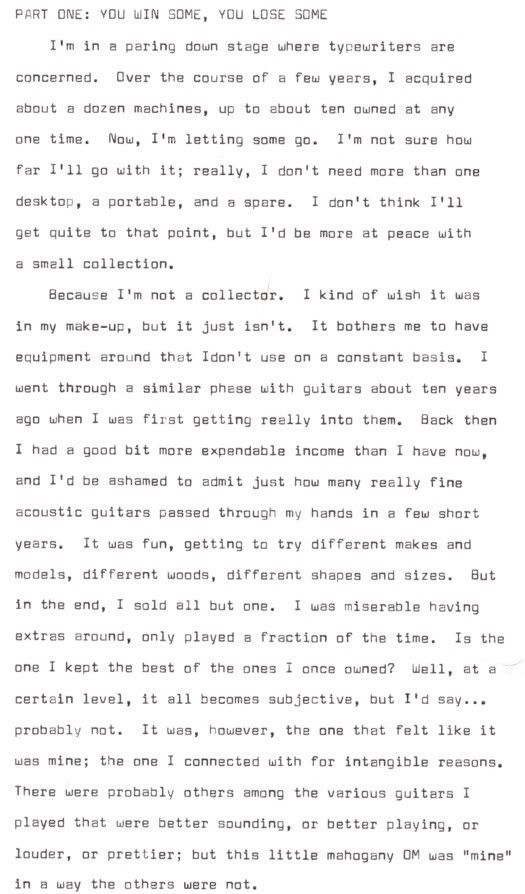
(In the interest of full disclosure, I do own two guitars now: one is a much less expensive but still mighty fine Recording King RO-127--I can't say enough about these guitars for those looking for something a bit better than dirt cheap, but still in the semi easy-to-replace ballpark. This one goes with me anywhere I'd be nervous about taking the Collings. Best bang for the buck out there, in my opinion.)

(Oh, and in the section below, there were two places where I meant to type SG-1 and typed SG-3 instead. You'll see what I mean.)


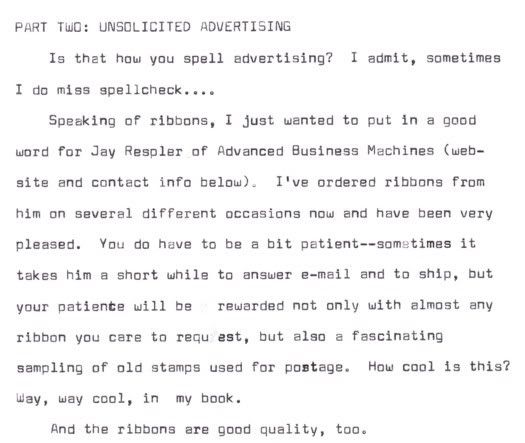
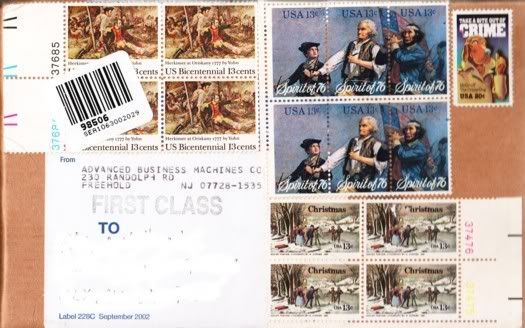
Jay Respler's contact info:
ADVANCED BUSINESS MACHINES CO.
230 RANDOLPH ROAD
FREEHOLD NJ 07728-1535
732-431-1464
JRespler@superlink.net
http://uweb.superlink.net/jrespler/

Tuesday, February 03, 2009

Everybody's doing it: 25 things

These things go around Facebook and the blogosphere every so often, and usually I just ignore them. But now I see even some of my fellow typecasters are jumping on the bandwagon. So...why not? Here ya go: 25 completely random facts about me. Try to stay awake.

1. I'm the oldest of eight: five boys, three girls. I waited ten years (and four brothers) for my first sister. Two of my brothers are married, and I now have four nieces and a nephew.

2. I grew up in Vermont (and still consider it home), but I was born in Portland, Oregon. One of the few things I remember about Portland is the ash from the Mt. St. Helens eruption. We moved to Vermont when I was three.

3. I spent four and a half years in the Air Force, mostly overseas in Germany (and a temporary duty assignment in Italy).

4. I didn't get my driver's license until I got out of the military. I was 23. Until then, I begged and borrowed rides, or rode my bike.

5. Ironically, the year I put the most miles on my bike was after I didn't hafta. Two years ago I rode the 25 mile round trip to work most days during the summer--there's a bike lane or path most of the way to work. This past year, I chickened out due to contruction along the route and increased traffic. Miss the ride, though.

6. I've written fiction and poetry and kept a journal off and on since...well...before I could even write. I don't know what if anything I'll ever do with any of that, but it's fun.

7. I play guitar, mando, and tenor-banjo-tuned-like-octave-mando. I'm still an advanced beginner on pretty much all of the above, but I have fun with it. I've played out a bit, though not since I've been in Washington.

8. I have too many pets: a devious and demanding Siamese cat named Tamino who plays fetch, a stupid but very sweet Himalayan/Siamese cross named Halvah Mom gave me one day out of the blue, a Lab/Border mix named Cisco who is basically what you'd get if Tigger was ever reincarnated as a dog, and two betta fish (Julian and Finnegan), one at work and one at home.

9. The vehicle I owned longest so far was a '97 Mercury Villager minivan. I had it for about five years, from late 2002 until early last year. It was about as uncool as a vehicle can get for a single gal. It was a blackhole for coolness. But it got us to lots of gigs and jams and fun trips, and it got me across country from Vermont to Colorado and Colorado to Washington, and I'll always have a soft spot for the thing.

10. I am a natural blonde. Very natural. So natural sometimes I scare myself.

11. I have a fascination for old writing technology, like fountain pens and manual typewriters. Ditto paper. And typefaces. And calligraphy.

12. I like to get up early and go to "my" coffee house (Mud Bay Coffee Roasters) to read and write while before work. I love that place, and the coffee. Given the opportunity, I'm afraid I'd end up the morning person/coffee equivalent of a barfly....

13. I really struggle with brevity when writing.

14. There are very few foods I don't like. Canned peas used to make me gag, and I think I'll pass on the smoked oysters. Other than that...can you pass me that plate?

15. I'm a Catholic.

16. I fairly frequently have nightmares where I wake myself up screaming. Then I try to figure out how I could fit that sequence into a story....

17. For my confirmation name I picked Mary Bernard, for St. Bernard of Clairvaux.

18. I use one eye for distance and the other for close-up.

19. I was homeschooled for six years: most of elementary school and part of high school.

20. I'm apt to strike out if people startle me. I don't do haunted houses anymore....

21. I usually read at least a book a week. Sometimes it's closer to a book a day. I try to keep some balance between the real literature and the brain candy.

22. I had my appendix removed when I was 13.

23. I had pulled pork barbecue for dinner. Or supper, if you prefer.

24. I once managed to kill a cactus plant by not watering it enough. This takes talent. Or something.

25. I saw "Tosca" at the Metropolitan Opera House in New York.

Wednesday, January 28, 2009

Sappy homesickness

This is one of those times of year I end up homesick for northern Vermont/New Hampshire. Yes, I miss them during the most frigid months of the year. And lately I've found myself babbling about night skies to anyone who will listen. Maybe this will help me move on. ;-)

Saturday, January 03, 2009

Sunday, December 28, 2008

Review: Renaissance Art custom composition book cover


Beautiful rustic brown leather...

I LOVE composition books. They're old friends. My oldest ones are now getting yellowed and crackly, but they date back to the mid-80s, so I guess they've done OK. I used them for journals, mostly, and for my early attempts at poetry and fiction. The oldest are thin, squashed down, with well-thumbed edges and bits of the white portion of the marble pattern and some of the letters filled in with blue ballpoint. Didn't everyone do that as a kid?

Even now that I've grown up and can afford more exotic and expensive notebooks, I still fall back on my old standard time and time again. They're cheap, readily available, comfortable and familiar. I still like to doodle in the top margin, scribble notes in the side margins. I still have times when I'll write a word three or four different ways inside the cover as I try to remember how to spell it, or do math problems (like figuring word count) in the margins or inside the covers. I love the size: not too small or too big. The wide ruling lets me stretch out a bit as I write. I like the way the pages crackle and pop at the stitching as you turn them.

And if you can find the Made in Brazil ones (Wal-mart usually has at least some, typically for less than a buck each), they're pretty fountain-pen friendly, too. You can write on both sides of the page with all but a really wet nib (or Noodler's Baystate Blue). There's occasionally some show-through, but very little bleeding or feathering. Much better than the Moleskine I'm currently using for a journal, for that matter.

Point is, I like 'em. But...let's face it, they're not exactly very stylin'.

Enter Renaissance Art.


Close-up of the tie

Renaissance Art is a small company that makes leather book covers, homemade journals, leather folios, etc. Their work has a rustic, old-world look to it. They have a strong following among folks on several of the writing related forums where I hang out, so I'd seen their name tossed around quite often. When I started looking for a cover to protect and add a bit of style to my cheap comp books, they were one of the first places I checked.

They don't list this particular cover on their site, but they'll make you pretty much anything you could wish. Since I was confused as to how to proceed, I dropped them an e-mail and got a very timely response in which I was directed to customize the large custom book cover to get what I wanted. I was able to easily customize it right there on the site. I went with brown leather, marked out the dimensions and noted that this was for a comp book, since Arthur (the company founder and typically the one who will respond to your messages) had mentioned they have them in the studio, and I figured they might be able to get a more accurate measurement in person.

The toughest part for me was picking a closure style. Normally for the standard book cover they offer either no type of closure (just a simple cover), a wrap and tie, or a strap that tucks into a couple of little loops to hold the book closed, medieval style. Since I carry my notebook chucked into a bag with lots of other stuff, some sort of closure was a given, to keep it all protected. I originally asked about having a wrap with a snap instead of the tie. It seemed the tidiest, least fussy way of keeping the book closed. For years, I've scorned any of those frou-frou journals with the tie closures. It just struck me as pretentiously earthy and silly. But in considering the snap, I started to think about the reasons why I'd disliked snaps on things like purses in the past: they can wear out eventually, for starters, though I think the ones RA uses aren't liable to do that any time soon. But if they do fail, they're hard to replace. Also, you have only one small spot where you can close the book, and you have to be precise. It means you also can't overstuff the thing with a stack of paper that day. Not very flexible. And it only holds in one spot--it doesn't snugly wrap around the whole book to hold it all together.

And when I finally broke down and played with a few of the tie style journals at the bookstore, I had to admit that in general, it was pretty easy to close them quickly.

I still feel a little self-conscious about the tie when taking out the notebook in public. But I have to take back much of my original thoughts on the subject. I like the tie. The one that came with the cover is very sturdy and attractive, and I can imagine it wouldn't be too difficult to replace if I eventually wear it out. It wraps around twice and tucks under--easy. I played with some tying methods as well, but a simple tuck works just fine. The biggest downside is that my two cats are *fascinated* by that long cord. Neato! A Tarzan rope just my size!


Cover open

I also had a medium sized pen loop added to the basic cover: the perfect size for a Parker 21/51 or other like-sized pens. Most of the time when I head somewhere with my notebook, I drag my whole bag along with me, but this lets me take it all together in one compact package if I so choose. The pen fits snugly into the nice long loop, and combined with the wrap, I have no fears of it falling out and being forever lost: something I *have* experienced with lesser loops in the past.

The turn around time was pretty amazing: I ordered Sunday night, it shipped Tuesday, I got it Thursday. I'm impressed! This wasn't just something to pull off a shelf, either: they had to build it right then.


Opening on the right makes it easier to insert the comp book

The comp book fits in perfectly. There are flaps on each side to hold it in, with the flap on the right being open to make it easier to work the book in. I tried to show that in my picture, but photography isn't my strong suit.

And the leather? Just wonderful. Soft and thick and with a wonderful depth of color. It should only become more attractive with time, and it feels great already. It did have a rather strong smell at first--a little *too* strong, and somewhat unpleasant. A remnant of the tanning process, I'd guess. It has faded fairly quickly to just a nice leather smell. It's not a polished and business like sort of leather, so there is that to keep in mind, and you can see that the pieces are cut and not just punched en masse. I like that aspect, personally.

I'm very pleased with it, and wanted to share it with the world, particularly since I know there are other composition book fans out there who might be interested in one of these puppies. I couldn't find any pictures when I was searching. Maybe this will help the next lost soul!

Tuesday, December 02, 2008

NaNoWriMo Redux, and paper and stuff

1. NaNoWriMo Redux:

Another year of NaNoWriMo insanity has come and gone, and I managed to squeak past the finish line for the sixth time. Yay, me! This was the second time I've handwritten it with fountain pens start to finish, in spite of my good intentions on the typewriter front. I don't exactly understand my own reasoning there. Part of it was that I'd started out by hand, figured out my average page count, and it was easier to stick with the figuring if I didn't switch methods. Partly I just liked (some of) the results I was getting. Partly I once again got all obsessed with fountain pens and ink, and I tend to focus on one obsession at a time. And I also got into the habit of hitting the coffee house at six thirty or seven every morning and writing for a solid hour before heading off to work. I'm still not at a point where I'm comfy lugging a typewriter into a very quiet early morning coffee house to type.

In any case, I finished. What have I learned? What did I come away with? Well, for the third year in a row, I have a story I think merits finishing and polishing. It needs considerable rewriting, but my stories always do. I'm a figure-it-out-as-I-go writer, and sometimes my stories are a bit like a game of telephone. I have to go back to the beginning and rewrite the scenes that I understand better now that the characters have fully evolved. But the story is moving. I have a head start; I've slogged through the sometimes tedious and scary initial stages of inventing characters and scenes and figuring out the skeleton of the plot. I love that about NaNo. I still have a good half the story to write, and a lot to trim away. I can't really blame NaNo for the bits that need trimming. It's more to do with my own tendencies as a writer: if I get stuck, I spin my wheels, and the story takes awhile to move on. Much of the wheel spinning will need to come out in the rewrite, but without it, I never hit the ground and move forward. Honestly, this is another reason paper works for me. I need to see all of those stages where I'm trying to figure out where to go or how to say something important. On paper, my character may say the same thing four different ways, and of course that's redundant. But now I can come back when the story is done--after I know *exactly* who that character is--and choose which of the four ways is really, truly them. I love that.

OK, now for some negativity. You know that old adage about monkeys on typewriters? Well, you know and I know it's a bunch of hooey. It doesn't matter how much time you give the monkeys, they'll never pound out anything but gibberish. Sometimes I feel like one of those monkeys. There are lots of inspirational little sayings out there about needing to write so many words of dross before being able to write a really good novel. But the truth is, you do need a certain amount of innate talent and creativity, or you're basically like one of those monkeys: no amount of time and effort and books and classes and critiquing is going to change the fact that there's a limit to just how good you're gonna get. Skills can only be honed within one's limitations. I tell myself that it doesn't matter, because I'm only writing for myself, but--and many of you can identify with this, I think--there's a little part of me that still wishes--at least some of the time, or now and again--that I could be that big famous author I dreamed of being when I was first learning to form sentences on paper. And there's still that little voice that says writing isn't worth it unless I am capable of doing just that, but I'm not, so why do I try? No matter how many times I tell that little voice to scram, it still pops up now and again to ridicule me and tell me that what I'm doing is pointless and painful and will only mean I leave piles of paper for people to laugh at when I'm gone.

Wretched thoughts. But can anyone identify sometimes, at least a little bit? I've been plotting ways to kill the little voice, but it tells me my ways aren't nearly creative enough. Poisoning with an antifreeze smoothie has been done. Shooting is soooo messy and overused. Dissolving with acid tends to muck up the carpeting if you drip....

2. Paper and stuff

Thanks to the guidance of fellow typecaster mpclemens and a 20%-off coupon I found on DIY Planner, I picked up some Circa/Rollabind disc-binding goods right before NaNoWriMo began. My entire 50,000 words fit into one letter-sized Circa notebook, on lovely fountain-pen-friendly heavy HP laser paper that I punched to fit. I also punched 3x5 cards to add notes in various places, especially questions and comments for the rewrite; added articles that I wanted to references; moved pages around or took 'em out as needed. It's a perfect system for a writer. You can combine typed pages, handwritten pages, reference material, pages of different sizes and shapes...all in one notebook that holds together nicely. I was impressed with how well it worked for me.

So, naturally, during the month I went to Wal-mart (during an hour when no one was there...) and picked up a stack of my old favorites: el-cheapo composition books (the Made in Brazil ones with nicer paper). This is my logic for you. Especially considering that the Circa stuff is a pretty hefty investment.

Not that composition books don't have their points, for sure. One thing that concerns me a bit about the Circa books is that you *can* move things around. It's not like anything fell out in spite of all the flipping through the book I did over the course of the month. It seems less likely to come apart than the average spiral book, honestly, especially if you use heavyish paper. But it's still an irrational fear of mine. I've never had a comp book tear in all my over twenty years or so of using them. And they're the perfect size. And they're cheap. And I am immediately comfortable with scribbling in the margins and drawing doodles at the top of the page and writing all my hard to spell words inside the covers, etc., etc. They're a well known and loved quantity.

But I can't mix them with typing or easily add any other information to them, and therein lies the rub. I usually just combine them with a smaller notebook for any notes that don't fit in the margins (since I number the pages, I can even mark what comp book and what page the notes apply to), but it's not quite the same as having one package. I like 'em both. I'll probably use both. I'm using a composition notebook for the next section of the story, for example, if only because I felt guilty about having 'em otherwise. But I struggle with the inconsistency of it all.

I'm fortunate that these are the complex issues of my life right now....

Wednesday, November 12, 2008

Subject to Subjectivity

There has been a great deal of recent talk on various blogs and boards about NaNoWriMo and, as a natural following point, the rights and wrongs of writing fiction. To an extent, I find the more pontificating posts laughable. We aren't discussing mathematics here. There aren't clear right and wrong ways to learn to write, or clear right and wrong ways to compose fiction, so long as the end result--not the first draft--is good. And even that is too subjective for any bold statement. "Good" is what is enjoyable to your target audience, whether that be a family member, fans of a particular genre, or just you. Beyond the technical details of grammar, vocabulary and spelling, there isn't a simple way to measure good prose. Just as a single example, I happen to despise Hemingway--despise is not too strong a word here. Both his style and his content completely rub me the wrong way. I do admire him for having such a distinctive style, and I think everyone should read at least one of his books just to glimpse that style--I'd recommend The Old Man and the Sea, which I almost didn't not like (double negative intended)--but I would never want to emulate him. His writing, to my mind, isn't good literature. I find it all but unreadable, and constantly wanted to rewrite it as I went through. Obviously, plenty disagree. His books sell; he has legions of fans. It doesn't really matter that I, personally, don't like his writing.

The process writers use--real writers, not just folks like me who write primarily for amusement--varies as greatly as their text. Again, an example: let me refer one more time to the Tess Gerritson comments I referenced a few posts back. She writes about teaching writing workshops with Michael Palmer. Both are successful authors in the medical thriller genre; both are what I would consider to be good writers from a technical standpoint. But they approach their stories from wildly different angles. Michael Palmer plans extensively, down to the smallest details. Tess says she has no idea where the story will go, and that she finds it impossible to plan ahead. They both get great results, in my opinion. Who's right? Wouldn't it be better to try both approaches for ourselves and see what works? Some writers write by hand or using a typewriter; some only use computers. Some writers produce a paragraph a day, some produce pages and pages; some edit extensively as they go along, some do major revision when they finish the draft in its entirety. If it works for them, it works. I get the impression that many of those who put NaNoWriMo down are those who have found that it is absolutely wrong for them. It isn't an approach that works for them; it makes them uneasy and uncomfortable. Maybe they are the sort of people who edit and revise as they go, perhaps, or who don't write every day, who mix projects, whatever the case might be.

But for me, I have to say, it was a revelation. I admit that I'm currently turned off a bit by the cult phenomenon it has become, with some participants trying to outdo one another in extremes; but the basic concept is sound: set a date, set a deadline, and commit to writing steadily, every day. And for all the talk about sleep deprivation and marathon caffeine-fueled writing binges, we really aren't talking absurd quantities here. We're talking well under 2000 words a day, every day for a month. This post comes to about half the daily total all on its own. The daily word count for NaNoWriMo can be completed in a few hours worth of writing, spread throughout a day.

Prior to my first NaNoWriMo, I'd never written anything that extensive. I was one of those geeky kids who always had a journal going, who carried a notebook and documented anything and everything, wrote poems, wrote stories, wrote. And I'd written technical documentation for work. But a longer fictional work--a rough draft for a novel--this was something mythical, something unreachable, something one had to be born to do. When a friend talked me into doing NaNoWriMo for the first time six years ago, I thought she was insane. But I battled my way through it, and finished the story. It isn't something I would show to anyone, but it taught me a great deal, nonetheless. I knew I was capable of that first step in novel writing, of producing the raw material of writing: the rough draft. I understood the ebb and flow of writing something of novel length. No, it wasn't a finished product. And I admit, although it's a semantic detail, I don't care to see the word "novel" used to describe works in progress. I always just say "story," which sounds juvenile, but at least not pretentious. To me, the word "novel" bespeaks a finished product, polished and published.

But many people would never achieve that raw material without NaNo to give them a kick in the pants. It's a good start. It won't make one a writer overnight--and I think anyone hanging out at the website would understand that most don't believe it will. If you don't care for it, so be it. But dismissing it entirely is shortsighted.

This post was drafted by hand, with pen and paper, and then typed and edited, 'cause that's what works for me....

Monday, November 10, 2008

Ugh.

I'm somewhere in the vicinity of 15k words now. Which puts me right at that stage when the shine starts to wear off my story. The realization dawns that as cool as it was in my head, all vague and swirly and brightly colored with lots of interesting characters and a few really awesome plot points to aim for, on paper it's plodding and pedantic and my characters don't do anything but talk in cliches and even *I* don't believe the rationale behind their actions. Not to mention I always tackle topics I know nothing about, without bothering to do any research. Last year, for example, I wrote a crime novel, despite knowing absolutely nothing about police procedures or court proceedings.

This year, I'm topping that by writing about brain science; about a future where memories can be eliminated. Yeah, very "Eternal Sunshine of the Spotless Mind", but to be fair, this is a topic I've tackled repeatedly since well before that movie came out. It's a subject that fascinates me because of the philosophical and moral questions that arise from it: can there really be experiences that only affect us in a negative way, or do we have the ability to learn something, to bring something positive from all experiences? How much of who we are comes from the sum total of experience, good and bad? Would it be wrong to eliminate almost all memories in order to start over, and if wrong, how wrong? And would we be the same people if we did, or something else entirely?

There's no way to answer these questions, but it's fun to play with them. At the same time, I'm really struggling just because it's all very complex: what would drive a person to do this? What kind of people would allow it and help them accomplish it? How would it affect their families and friends? And what about practical concerns: how would they establish a new identity from a legal standpoint if they completely started over? How would they make a living? In my own world, I can sort of make that up as I go along, but I'm feelin' a bit overwhelmed, and the story isn't the wonderful shiny thing I would like it to be.

But I'll keep plugging along, hoping I can polish it up in the next draft. I gotta keep repeating that to myself. Otherwise, I'm gonna go nuts. It's all very traumatizing. Maybe could do with some memory erasure myself.

Tuesday, November 04, 2008

Procrastination: who needs internet?

I can procrastinate marvelously even whilst on restriction. *sigh*


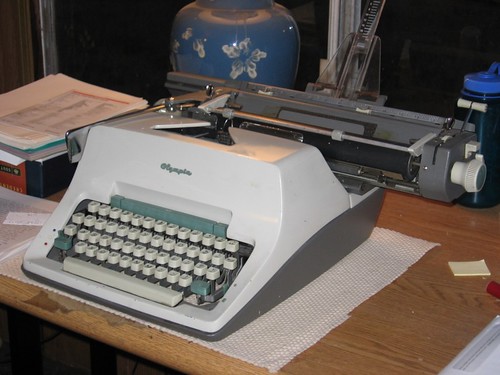
This gives another point to the Neos and typewriters. Can't do much with them but write. Well...except make typewriter images, but I'm not artistic enough for that.

Now I'm off to a coffee house to write for a bit before work. With a bit of luck, I'll more than make up having a slightly skimpy day yesterday.