I'll of course be over-obsessively researching these topics elsewhere--it's what I do--but I figure some of you smart folks might have some first-hand input for me.
I'm so close to finishing the rough draft of my latest long story that I'm finally starting to feel the wind in my hair on that last downhill slide. Don't get me wrong--it'll probably be a month or so before I can write "THE END." What's left is bound to be something of a slow slog, and I'm an exceptionally slow slogger, especially in the summer. Still, for once I pretty much know what's going to happen, overall. I just have to get it all down and fill in the details.
I really want to edit this one to completion. Which brings me to the two topics of the day.
1. Novel editing software
I've never used any. I've also never completely finished editing one of my novels. Inevitably, I end up frustrated with the word processor, because as soon as I start shuffling scenes around, I lose them and have to scroll and scroll and scroll and scroll looking for where I left that one paragraph. I also waste all kinds of time trying to remember details like what time of year it was when X had a birthday or A and B first met, or what color eyes I gave to Minor Character D. Is there such a thing as software that will let you parcel a story out into scenes, keep track of a time line, and with a section for character sketches? Those are the main things I think would be most useful to me. Like I said, I'll do the research (and how), but I'd appreciate any input. I'm a PC user, if that makes a difference.
2. Them there new-fangled netbook thingies
One of the things I've learned over the past six months is that I'm far more productive if I get out of the house. I'm sure a part of that has been lack of internet access (I've been writing strictly by hand), but I think a good portion of it is just being in a different environment. I work better if I detatch from the rest of my life for an hour or so.
With that in mind, I've been wondering how I could continue with the morning coffee house run, but do transcribing and some in-depth editing instead of writing, and I've been pondering picking up one of these little guys. They appeal to me because:
a)they're cheap
b)they're very portable (I could stick one in my purse, even
and c)the newer ones get five hours or more of battery life, so I wouldn't have to carry any kind of power supply.
I went to Best Buy the other day to just see what they looked like in person. The 8.9" models were a little too toy-like, in my opinion. I could see using them for surfing, but not real extended use. But the 10.1" were surprisingly usable. I didn't have any trouble with the keyboards on most. My favorite, surprisingly to me, was the ASUS model with the chiclet keyboard. I expected the keys to feel like calculator buttons, but they were...just fine. I have big hands, but skinny fingers, and I could type without any real loss of accuracy. The screen is small, but I think would be fine for my purposes. And the specs are actually better than my primary home PC. Go figure. Has anyone used one of these extensively and have any input on the various brands / downsides that might not be obvious at first glance? Thoughts, suggestions, snarky remarks?
They seem like the perfected version of the Toshiba Libretto, which I lusted after mightily back in the day....

Friday, May 22, 2009


Thursday, May 14, 2009
Spirit of the Northwest

Coming from rural Vermont where coffee houses and espresso stands are all but unheard of, and where any coffee drink more involved than coffee with cream and sugar tends to be regarded with distrust and disgust, I'm often amused by Western Washington's juxtapositions. Gotta love it.
Saturday, May 09, 2009

Friday, May 08, 2009
Regularly irregular musings
So...how are the typecasting journal entries coming along? I'm just about done with the final draft of the story I *may* be submitting. It's a short short, I think. The terminology for short stories is all new to me. This is uncharted territory: well out of my comfort zone.
I'm one of those people who's never had a serious problem finishing NaNoWriMo. No, it isn't easy, but if I force myself to sit down and put one word in front of another for a few hours every day, I can do it. I'm not one of those crazy people who can sit and pound out 4000 words in a sitting (had a roommate during one NaNo who was, and it annoyed the snot out of me, I admit) but I can write a decent number of words steadily day after day. And my stories usually start out much too wordy and then gets whittled down. If brevity is the soul of wit, my wit (such as it is) is some sort of soulless wraith.
As a result, this story has been an incredible challenge for me. It's the anti-NaNo: saying as much as possible in the fewest possible words; implying details and descriptions some of the time rather than sketching them out, leaving most of the color and scenery and background to the imagination of the reader. In a thousand words, you can't do much more than capture a single snapshot in your characters' lives, or the borders and boldest lines. I'm not good at it. It makes me cranky. Therefore, this is probably good for me.
And speaking of difficult-but-potentially-good-for-me activities, is anyone else semi-terrified by the concept of revealing a fictional work to even a small subset of the big wide world? I sure am. For one thing, I always worry that my stories are, as a high school English teacher once put it to me, too "bleeding heart." But it's more than that. Fiction is an entirely different animal than non-fiction. Why is that? (Rhetorical question.)
In one of my notebooks, I came across something I had written to the effect that nonfiction reveals one's thoughts and opinions; fiction one's heart and soul. I'm not sure I really believe that--I think I just liked the way it sounded when I wrote it down. But why *are* we more self-conscious about make-believe? Or am I the only one who feels this way?
On another subject, I read with interest the pocket briefcase vs pocket Moleskine throw-down Strikethru linked to here. My International Pocket Briefcase arrived a few days ago, courtesy of the Levenger outlet on eBay. It was cheaper than the Franklin Covey version I posted about here, once I factored in local tax (right about $16). Pretty cool.
Since it's larger than the shirt pocket briefcase listed in the review, it's not quite as direct a comparison--I'm using it as a wallet as well as a notepad. But the Moleskine has been my carry-everywhere writing surface up to now, so the comparison is there. Since I'm a gal and rarely have a pocket that would hold either one, the size differences aren't as crucial. It comes down to the format differences. On the one hand, the notebook means you carry everything you've written around with you, so you always have it. On the other hand, the cards let you carry just the important stuff, toss the grocery lists and memos, and organize into categories at home. It's more flexible, but less contained. It's my Circa vs composition book dilemma in miniature, and time will tell how I feel about it. I foresee still using the Moleskine for longer entries.
As for the wallet itself, it is marvelously soft but sturdy feeling leather--smells wonderful. There's a little more wiggle-room for the cards than there was in the cheaper one, which I'm very grateful for--makes it much easier to get them in and out, and the writing surface will hold about three or four cards in a stack without complaining. The wallet side where there's space for cash and receipts has a shallower little area for paper money, instead of just being a deep gaping pocket where narrower items get lost. All in all, a step up, and I think I can live with the fake initials....
I'm one of those people who's never had a serious problem finishing NaNoWriMo. No, it isn't easy, but if I force myself to sit down and put one word in front of another for a few hours every day, I can do it. I'm not one of those crazy people who can sit and pound out 4000 words in a sitting (had a roommate during one NaNo who was, and it annoyed the snot out of me, I admit) but I can write a decent number of words steadily day after day. And my stories usually start out much too wordy and then gets whittled down. If brevity is the soul of wit, my wit (such as it is) is some sort of soulless wraith.
As a result, this story has been an incredible challenge for me. It's the anti-NaNo: saying as much as possible in the fewest possible words; implying details and descriptions some of the time rather than sketching them out, leaving most of the color and scenery and background to the imagination of the reader. In a thousand words, you can't do much more than capture a single snapshot in your characters' lives, or the borders and boldest lines. I'm not good at it. It makes me cranky. Therefore, this is probably good for me.
And speaking of difficult-but-potentially-good-for-me activities, is anyone else semi-terrified by the concept of revealing a fictional work to even a small subset of the big wide world? I sure am. For one thing, I always worry that my stories are, as a high school English teacher once put it to me, too "bleeding heart." But it's more than that. Fiction is an entirely different animal than non-fiction. Why is that? (Rhetorical question.)
In one of my notebooks, I came across something I had written to the effect that nonfiction reveals one's thoughts and opinions; fiction one's heart and soul. I'm not sure I really believe that--I think I just liked the way it sounded when I wrote it down. But why *are* we more self-conscious about make-believe? Or am I the only one who feels this way?
On another subject, I read with interest the pocket briefcase vs pocket Moleskine throw-down Strikethru linked to here. My International Pocket Briefcase arrived a few days ago, courtesy of the Levenger outlet on eBay. It was cheaper than the Franklin Covey version I posted about here, once I factored in local tax (right about $16). Pretty cool.
Since it's larger than the shirt pocket briefcase listed in the review, it's not quite as direct a comparison--I'm using it as a wallet as well as a notepad. But the Moleskine has been my carry-everywhere writing surface up to now, so the comparison is there. Since I'm a gal and rarely have a pocket that would hold either one, the size differences aren't as crucial. It comes down to the format differences. On the one hand, the notebook means you carry everything you've written around with you, so you always have it. On the other hand, the cards let you carry just the important stuff, toss the grocery lists and memos, and organize into categories at home. It's more flexible, but less contained. It's my Circa vs composition book dilemma in miniature, and time will tell how I feel about it. I foresee still using the Moleskine for longer entries.
As for the wallet itself, it is marvelously soft but sturdy feeling leather--smells wonderful. There's a little more wiggle-room for the cards than there was in the cheaper one, which I'm very grateful for--makes it much easier to get them in and out, and the writing surface will hold about three or four cards in a stack without complaining. The wallet side where there's space for cash and receipts has a shallower little area for paper money, instead of just being a deep gaping pocket where narrower items get lost. All in all, a step up, and I think I can live with the fake initials....
Friday, May 01, 2009
We're just cool like that
Couple of days ago I was driving home from work, just minding my own business, when I was startled by someone laying on their horn right next to me. I looked over to see what was going on, and it was a guy in a Corolla just like mine, but green. He pointed exaggeratedly at my car a few times and gave me a huge grin and a big thumbs up. I was too startled to do much more than wave before he had zoomed on ahead.
Corolla guy, if you're out there, a big honk back. 'Cause we Corolla people, we're way cooler than people give us credit for.
Corolla guy, if you're out there, a big honk back. 'Cause we Corolla people, we're way cooler than people give us credit for.
Thursday, April 30, 2009
What I did this weekend....
Aside from spending time obsessing about 3x5 cards, that is. I went to a really awesome music workshop!
Warning: I lazily cut and pasted this from a post I made to the FLATPICK-L guitar list, which means a high percentage of the content would likely only be of interest to fellow guitar nerds.
--BEGIN PASTED STUFF--
Steve Kaufman's workshops may just be the next best thing to his Kamp. And in his workshops, you get him for an entire day and a half, instead of just one class out of a week. (See other Kamp references on my blog here)
This particular workshop (pulled together by the Winlock Bluegrass Organization and Marv's Music) was held on April 24th and 25th, and was the first time I'd attended one of Steve's full workshops. I had high expectations, based on two trips to Kamp in 2001 and 2008, and such of his teaching materials as I've been able to accumulate. I wasn't disappointed. He's a masterful teacher, and a fun entertainer. More than that, one thing I've learned through workshops and Kamps is that although you can (and should!) learn something from every teacher and performer, now and again there will be one who speaks your language: someone whose methods just click for you, and turn on that little light bulb in your head. Not all of us will connect with the same people, of course--we learn in different ways and have different approaches to music. But Steve just makes sense to me.
The workshop was held at the old Yardbirds Mall in Chehalis, WA. I'd never been there before, but contrary to my usual method of operation, I found the place on my first try--it's kind of hard to miss the GIANT black bird sculpture out front. Too bad these can't always be used as landmarks for events--sure would make my life easier if I could just always look for ENORMOUS cartoon crows.
The mall used to be one of the biggest shopping centers in the area. These days, it's primarily an event center, with the downstairs portion taken up by lots of quirky little shops on one side and a grocery store on the other. We were upstairs, in a big room labeled "the Bird's Nest."
Since not everyone was able to make it to the evening session, and some people had had a long travel day, Steve kept Friday evening pretty laid back. He let us get all the gear questions out of the way, and showed off his beautiful red spruce / bubinga Ken Miller guitar. (Incidentally, bubinga is really fun to say. Bubinga, bubinga, bubinga!) He talked a bit about his too-thin yaller picks and why he likes them. He also had us write down some of the topics and tunes we wanted to work on the following day, showed us a little crosspicking and went over some rhythm techniques and bass runs.
Saturday was more intense. It started off with what he called the Saturday Morning Hot Seat. He went through the tunes we'd written down the day before, and for each tune, called up a victim...er...volunteer, and had them play it with him. Then we talked a bit about the tune. We covered Salt Creek, Bill Cheatham, Black Mountain Rag, St. Anne's Reel. Everyone did pretty good. Somewhere in the middle there I *almost* nodded when Steve said he'd go through Blackberry Blossom in a minute, which made me a volunteer. By the time Steve and another student were about halfway through St. Anne's Reel (Blackberry Blossom being next), I was already shaking and my hands were going clammy. But, hey, I told myself, I can do this. Blackberry Blossom is one of the tunes I've played and played and played with the Bluegrass Workout CDs. I was worried about flubbing the chords when my turn came to play backup, but I figured I could handle the melody. Then I actually got up there.
Aaand I was shaking so hard I could barely hit the strings, I blanked out on huge sections of the tune, I frantically hit random notes, and just generally made a mess of things until I finally just came to a crashing halt. And Steve made me play it again! Several times. The very last time through, I almost played the right notes in the B part. Yay me! But I was still shaking so hard my teeth were practically chattering. I can't say my performance was a resounding success. At the least, though, maybe some of the other students who were nervous about getting up there can think, "Well, at least I could do better than *that*...."
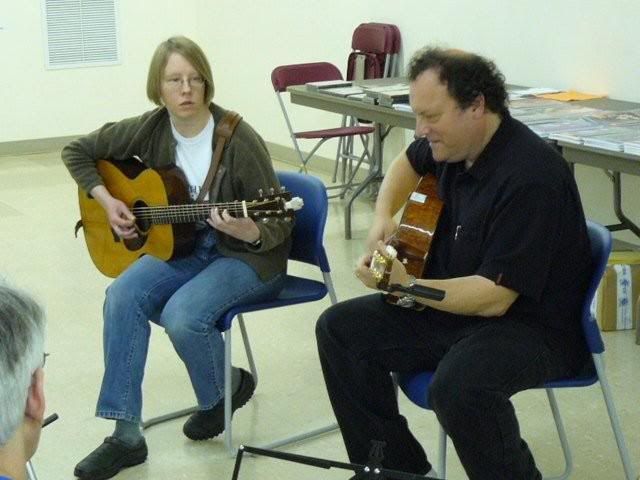
Me in the hot seat: note my deer-in-the-headlights expression.
As I walked back to my seat, Steve said, "Now, you do that again next chance you get! That's how you get over performance anxiety!" Oh, goody! My poor bruised ego was screaming, "Do it again? Are you kidding?? Don't you *dare* do that to me again!" But I reckon I'm fool enough to try.
Over the course of the rest of the day, we learned Mississippi Sawyer and did some crosspicking. Steve pulled a sneaky one on us, though: he taught us a seemingly random little progression and had us work on it piece by piece for a good portion of the afternoon. Then he put it all together and, like magic, there was a crosspicked arrangement of the first part of Wildwood Flower.
Interspersed between it all, Steve dispensed wisdom on allocation of practice time, getting volume and power out of your playing, and why it's important to work on your down-ups. I want to work on his wide swing attack--my volume needs all the help it can get. And I know pick direction is one of the biggest reasons I have points in tunes where I get mixed up: it would behoove me to slow down and really concentrate on the down-ups for awhile. He also talked about the importance of repetition when learning tunes, which was something I needed to hear. I love pretty tunes, and I'm able to toddle off after more and more pretty tunes without really learning the ones I already have.
After the workshop, there was a bit of jamming, and later in the evening, Steve's concert down at the Hub City Cafe in Centralia, WA. (I got lost on the way there. See above about ENORMOUS cartoon crows. I'm tellin' ya...it'd really help me out!) Marv's band, the Black River Band opened, and did a fine job. I especially liked their rendition of "The Water is Wide," and Joan Smith's original song at the end of their set. Then Steve came out and started out by tearing it up on a fiddle tune medley segueing into some fingerpicking. Good stuff. The whole set was good. I think my favorites were the waltzes, just because I'm a sucker for waltzes--he did a really pretty harmonics bit at the end of Festival Waltz, and Ookpik is an old favorite of mine. He ended it off with a medley that started with Over the Waterfall--another favorite of mine.
All in all, a great time! Kind of a little taste of Kamp.
Warning: I lazily cut and pasted this from a post I made to the FLATPICK-L guitar list, which means a high percentage of the content would likely only be of interest to fellow guitar nerds.
--BEGIN PASTED STUFF--
Steve Kaufman's workshops may just be the next best thing to his Kamp. And in his workshops, you get him for an entire day and a half, instead of just one class out of a week. (See other Kamp references on my blog here)
This particular workshop (pulled together by the Winlock Bluegrass Organization and Marv's Music) was held on April 24th and 25th, and was the first time I'd attended one of Steve's full workshops. I had high expectations, based on two trips to Kamp in 2001 and 2008, and such of his teaching materials as I've been able to accumulate. I wasn't disappointed. He's a masterful teacher, and a fun entertainer. More than that, one thing I've learned through workshops and Kamps is that although you can (and should!) learn something from every teacher and performer, now and again there will be one who speaks your language: someone whose methods just click for you, and turn on that little light bulb in your head. Not all of us will connect with the same people, of course--we learn in different ways and have different approaches to music. But Steve just makes sense to me.
The workshop was held at the old Yardbirds Mall in Chehalis, WA. I'd never been there before, but contrary to my usual method of operation, I found the place on my first try--it's kind of hard to miss the GIANT black bird sculpture out front. Too bad these can't always be used as landmarks for events--sure would make my life easier if I could just always look for ENORMOUS cartoon crows.
The mall used to be one of the biggest shopping centers in the area. These days, it's primarily an event center, with the downstairs portion taken up by lots of quirky little shops on one side and a grocery store on the other. We were upstairs, in a big room labeled "the Bird's Nest."
Since not everyone was able to make it to the evening session, and some people had had a long travel day, Steve kept Friday evening pretty laid back. He let us get all the gear questions out of the way, and showed off his beautiful red spruce / bubinga Ken Miller guitar. (Incidentally, bubinga is really fun to say. Bubinga, bubinga, bubinga!) He talked a bit about his too-thin yaller picks and why he likes them. He also had us write down some of the topics and tunes we wanted to work on the following day, showed us a little crosspicking and went over some rhythm techniques and bass runs.
Saturday was more intense. It started off with what he called the Saturday Morning Hot Seat. He went through the tunes we'd written down the day before, and for each tune, called up a victim...er...volunteer, and had them play it with him. Then we talked a bit about the tune. We covered Salt Creek, Bill Cheatham, Black Mountain Rag, St. Anne's Reel. Everyone did pretty good. Somewhere in the middle there I *almost* nodded when Steve said he'd go through Blackberry Blossom in a minute, which made me a volunteer. By the time Steve and another student were about halfway through St. Anne's Reel (Blackberry Blossom being next), I was already shaking and my hands were going clammy. But, hey, I told myself, I can do this. Blackberry Blossom is one of the tunes I've played and played and played with the Bluegrass Workout CDs. I was worried about flubbing the chords when my turn came to play backup, but I figured I could handle the melody. Then I actually got up there.
Aaand I was shaking so hard I could barely hit the strings, I blanked out on huge sections of the tune, I frantically hit random notes, and just generally made a mess of things until I finally just came to a crashing halt. And Steve made me play it again! Several times. The very last time through, I almost played the right notes in the B part. Yay me! But I was still shaking so hard my teeth were practically chattering. I can't say my performance was a resounding success. At the least, though, maybe some of the other students who were nervous about getting up there can think, "Well, at least I could do better than *that*...."
Me in the hot seat: note my deer-in-the-headlights expression.
As I walked back to my seat, Steve said, "Now, you do that again next chance you get! That's how you get over performance anxiety!" Oh, goody! My poor bruised ego was screaming, "Do it again? Are you kidding?? Don't you *dare* do that to me again!" But I reckon I'm fool enough to try.
Over the course of the rest of the day, we learned Mississippi Sawyer and did some crosspicking. Steve pulled a sneaky one on us, though: he taught us a seemingly random little progression and had us work on it piece by piece for a good portion of the afternoon. Then he put it all together and, like magic, there was a crosspicked arrangement of the first part of Wildwood Flower.
Interspersed between it all, Steve dispensed wisdom on allocation of practice time, getting volume and power out of your playing, and why it's important to work on your down-ups. I want to work on his wide swing attack--my volume needs all the help it can get. And I know pick direction is one of the biggest reasons I have points in tunes where I get mixed up: it would behoove me to slow down and really concentrate on the down-ups for awhile. He also talked about the importance of repetition when learning tunes, which was something I needed to hear. I love pretty tunes, and I'm able to toddle off after more and more pretty tunes without really learning the ones I already have.
After the workshop, there was a bit of jamming, and later in the evening, Steve's concert down at the Hub City Cafe in Centralia, WA. (I got lost on the way there. See above about ENORMOUS cartoon crows. I'm tellin' ya...it'd really help me out!) Marv's band, the Black River Band opened, and did a fine job. I especially liked their rendition of "The Water is Wide," and Joan Smith's original song at the end of their set. Then Steve came out and started out by tearing it up on a fiddle tune medley segueing into some fingerpicking. Good stuff. The whole set was good. I think my favorites were the waltzes, just because I'm a sucker for waltzes--he did a really pretty harmonics bit at the end of Festival Waltz, and Ookpik is an old favorite of mine. He ended it off with a medley that started with Over the Waterfall--another favorite of mine.
All in all, a great time! Kind of a little taste of Kamp.
Sunday, April 26, 2009
Madness comes in 3x5
So...way back before November, I decided that this was going to be the year when I organized my NaNoWriMo story ahead of time. To that end, and partially based on what I saw others doing, I bought a bunch of index cards and a box to put 'em in. I did use a good portion of the index cards--I wrote up lists of potential character names, colors, and other brain joggers for those times when I got stumped. And I wrote character and scene sketches for my story as I pictured it.
Then I started writing.
As I've mentioned here before, and as I keep having to relearn, I cannot write to an outline or preconceived notions. Can't. It's an exercise in frustration. My stories and characters become what they are as I write them, and they very rarely have much in common with the original idea. At this point, I think I have to just accept this and work with it.
But the bottom line is that all those index cards filled with bright ideas and carefully scripted scenes ended up being useless. My main character slipped to second place and turned into a little spitfire of a gal instead of the elegant, cold woman of the world she was meant to be; characters I'd never imagined showed up and brought their lives with them; the world they they all inhabited changed to a completely different location and time...and I never used a single one of my cards. Not one. I tucked them away (except my idea cards) and chalked it up to experience.
But then, not too long ago, I grabbed one of those blank cards when I was hunting for something to use for a grocery list. I felt guilty about using card stock for something so trivial, but I liked the size, and that it held up well in my pocket. I reused it and scribbled to-dos on the back. I started carrying index cards with me and used them for more lists--I love lists. I wrote down ideas for more writing: nothing fully formed, just random ideas and words I wanted to include, or vague lines that sounded nice in my head, or notes on things I'd seen and heard that stirred my imagination.
Now I'm coming to the realization that I'm addicted, or could become so if I let myself. I usually scribble most of these things in a notebook, but with the index cards, I can toss any that have outlived their usefulness or been transcribed, keep works-in-progress and long-term reference items at the front of the stack instead of having them end up pages behind, and even organize into categories. They are just about the perfect everyday scribbling surface.
So...here comes the weekend's binge. 'Cause when I fall off the wagon, I fall hard. You thought last week was bad? Ha! Look at this!
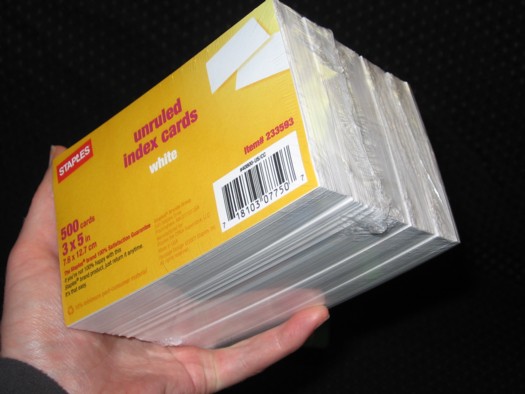
Can you feel the power? Can you? You envy me, you know you do. Four bucks for this massive stack at Staples. And I like that they had the unlined ones in the same quantities and not relegated to second-class status.
And then, because I needed a new wallet/money and credit card carrier of some sort anyway, I picked up this little thing at Office Depot. It was labeled as a FranklinCovey Task List Wallet (on-line they just call it a Leather Index Card Holder), and came with some cheap 3x5 cards marked with task lists--I doubt I'll even use them. I had a hard time photographing this since it's black and all, so you'll have to pardon the less than elegant backdrop.
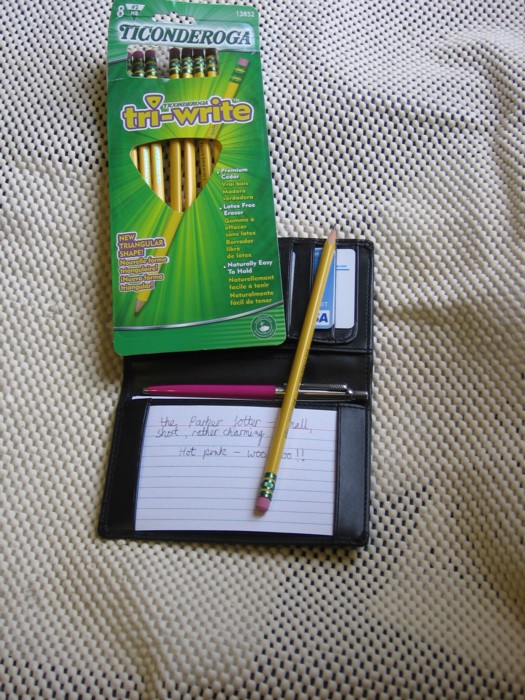
It holds a few cards on the writing surface (the ends of the card tuck under), and has room for additional cards underneath, or on the other side. There's also a pen slot, room for credit cards, and--underneath the pencil box--a clear window for ID. It also has a slot for cash, but since this wallet is so deep (over 5 inches) it feels a little funny putting money in there. I'll probably use that slot for the occasional single check or receipts. Or more cards. I note the Office Depot product page says this has a ten card capacity--I'm assuming they're *only* counting the space behind the writing surface.
It feels...OK. It's a far cry from the Levenger Pocket Briefcase it emulates, but it also doesn't cost an arm and a leg.
The pen slot is a little shorter than the average pen, and a thick pen means the wallet doesn't fold as neatly as it should. So...I splurged a little more and got a Parker Jotter. Isn't it cute?? Love that they come in bright pink!
Oh, and those pencils? Well...what can I say? I didn't have any pencils. Therefore I needed them, right? I love the way Ticonderoga pencils smell...mmmm! My cats are also strangely fascinated by them, though. I wrote with one of them for awhile this afternoon and Halvah insisted on sitting right next to me, sniffing loudly. Like gal, like cat?
Then I started writing.
As I've mentioned here before, and as I keep having to relearn, I cannot write to an outline or preconceived notions. Can't. It's an exercise in frustration. My stories and characters become what they are as I write them, and they very rarely have much in common with the original idea. At this point, I think I have to just accept this and work with it.
But the bottom line is that all those index cards filled with bright ideas and carefully scripted scenes ended up being useless. My main character slipped to second place and turned into a little spitfire of a gal instead of the elegant, cold woman of the world she was meant to be; characters I'd never imagined showed up and brought their lives with them; the world they they all inhabited changed to a completely different location and time...and I never used a single one of my cards. Not one. I tucked them away (except my idea cards) and chalked it up to experience.
But then, not too long ago, I grabbed one of those blank cards when I was hunting for something to use for a grocery list. I felt guilty about using card stock for something so trivial, but I liked the size, and that it held up well in my pocket. I reused it and scribbled to-dos on the back. I started carrying index cards with me and used them for more lists--I love lists. I wrote down ideas for more writing: nothing fully formed, just random ideas and words I wanted to include, or vague lines that sounded nice in my head, or notes on things I'd seen and heard that stirred my imagination.
Now I'm coming to the realization that I'm addicted, or could become so if I let myself. I usually scribble most of these things in a notebook, but with the index cards, I can toss any that have outlived their usefulness or been transcribed, keep works-in-progress and long-term reference items at the front of the stack instead of having them end up pages behind, and even organize into categories. They are just about the perfect everyday scribbling surface.
So...here comes the weekend's binge. 'Cause when I fall off the wagon, I fall hard. You thought last week was bad? Ha! Look at this!
Can you feel the power? Can you? You envy me, you know you do. Four bucks for this massive stack at Staples. And I like that they had the unlined ones in the same quantities and not relegated to second-class status.
And then, because I needed a new wallet/money and credit card carrier of some sort anyway, I picked up this little thing at Office Depot. It was labeled as a FranklinCovey Task List Wallet (on-line they just call it a Leather Index Card Holder), and came with some cheap 3x5 cards marked with task lists--I doubt I'll even use them. I had a hard time photographing this since it's black and all, so you'll have to pardon the less than elegant backdrop.
It holds a few cards on the writing surface (the ends of the card tuck under), and has room for additional cards underneath, or on the other side. There's also a pen slot, room for credit cards, and--underneath the pencil box--a clear window for ID. It also has a slot for cash, but since this wallet is so deep (over 5 inches) it feels a little funny putting money in there. I'll probably use that slot for the occasional single check or receipts. Or more cards. I note the Office Depot product page says this has a ten card capacity--I'm assuming they're *only* counting the space behind the writing surface.
It feels...OK. It's a far cry from the Levenger Pocket Briefcase it emulates, but it also doesn't cost an arm and a leg.
The pen slot is a little shorter than the average pen, and a thick pen means the wallet doesn't fold as neatly as it should. So...I splurged a little more and got a Parker Jotter. Isn't it cute?? Love that they come in bright pink!
Oh, and those pencils? Well...what can I say? I didn't have any pencils. Therefore I needed them, right? I love the way Ticonderoga pencils smell...mmmm! My cats are also strangely fascinated by them, though. I wrote with one of them for awhile this afternoon and Halvah insisted on sitting right next to me, sniffing loudly. Like gal, like cat?
Saturday, April 18, 2009
Random heretical thoughts, plus more backsliding
I am something of a retrogrouch. Big surprise there. I've gone on record saying that electronic books will never catch on (for me, in any case), that ink and paper is still the best way to record thought, that I can't imagine why anyone would rely on devices that require power.
But this week, I've had to eat my words, somewhat, not once but twice.
First of all, I got to play with a Kindle 2 that some friends recently received, and I have to say, that is one cool little device. I was shocked, for starters, that it looks like...well...ink on paper. It's a far cry from reading text on a backlit PDA type of device. It's easy on the eyes and has the contrast, pretty much, of regular paper, BUT it lies perfectly flat, you can resize the text if you wish, the pages turn at the press of a button, you can easily jump to any given page, search for words...it's almost the best of both worlds. Not that I'm ready to drop $350 on one, but I'm still impressed. Especially considering all the free books available on sites like Gutenberg.org. (I WUVVVV Gutenberg.org!!!) I'd still have worries about battery life, and the fact that any device like that can malfunction and cut you off from your reading material, and that technology changes while printed written material will still be readable without a special device for lifetimes. But I admit, I can see these digital thingies having a place in the world. I'd never give up my real books, but it'd be nice to be able to carry *all* your favorite books and all your favorite reference books on a trip in a two pound package, ya know?
The second instance of anti-Luddite "oooh, cool technology!" I experienced this week was in reaction to a Livescribe pen one of my coworkers picked up. This is one nifty little gadget. It works like a regular ball point pen, but as you write on special dot matrix paper (but it *is* paper!) it records your pen strokes. You can simultaneously record the audio of whatever you're taking notes on, and can later tap that section to hear the audio that was occurring as you were writing. It lets you save your handwritten notes in image form (there are add-ons that are supposed to do handwriting recognition, but I have no idea how well those work), and again, you can search for keywords. I don't know how it identifies the words within regular handwriting, but it seems to be pretty accurate. Magic. And, of course, you still have your handwritten notes to refer to should everything crash.
You can also print pages with the dot matrix grid on regular paper, which makes my Circa/Rolla-loving self twittery. It requires a color laser, though, so it may not be practical for most.
I think the Livescribe is still new enough that there are kinks to work out, but I'm fascinated by this melding of technology with reg'lar old writing on paper. It pleases me. I think it's a far more realistic and practical approach to sci-fi-like technology than a complete movement away from paper and pens and other manual ways of getting data down.
No financial involvement in either of these toys...I can't afford 'em. ;-) But I reluctantly admit that they're pretty darned cool.
As for myself, I'm still quite happy with pen and paper for most purposes. I do a ton of taking notes and making hand-written to-do lists at work: things stick in my head better that way. I go through a lot of notebooks (usually steno pads) and save old ones so I can refer back. I also tend to scribble down to-do lists or notes or poems or other writing for home in the midst of everything and tear them out, leaving me with raggedy steno pages all over the house, tucked into my home notebooks and journal, and in the pockets of my bag.
I'm about to finish another pad at work, after which I'm experimentally going Rollabind for a bit. It will mean I can stick pages from my work notebook into my home one without a problem, and also I can pick my own paper (woo-hoo!): something that will work with fountain pens if I wish--and unlined, which I've come to prefer most of the time. I like the smaller Junior sized for at work since it takes up less real estate on the desk, so today I bought a Rollabind notebook at Staples for five bucks (yes, expensive for a notebook...but it's a reuseable cover), and a ream of good paper. I took the paper to Kinkos and had them cut it in half to fit the cover nicely. It only cost about a buck fifty for the cut, so it was worth it. I now have a thousand pages worth of notebook paper--should be enough to last me for at least a coupla years.... The paper is actually a little too big for the cover (I think Levenger's covers are a little longer, but I could be wrong), but since this will mostly live on a desk, and I just need the cover as an occasional hard surface to write on when I'm taking notes without a table, I can live with the imperfection.
Mmm...paper....
But this week, I've had to eat my words, somewhat, not once but twice.
First of all, I got to play with a Kindle 2 that some friends recently received, and I have to say, that is one cool little device. I was shocked, for starters, that it looks like...well...ink on paper. It's a far cry from reading text on a backlit PDA type of device. It's easy on the eyes and has the contrast, pretty much, of regular paper, BUT it lies perfectly flat, you can resize the text if you wish, the pages turn at the press of a button, you can easily jump to any given page, search for words...it's almost the best of both worlds. Not that I'm ready to drop $350 on one, but I'm still impressed. Especially considering all the free books available on sites like Gutenberg.org. (I WUVVVV Gutenberg.org!!!) I'd still have worries about battery life, and the fact that any device like that can malfunction and cut you off from your reading material, and that technology changes while printed written material will still be readable without a special device for lifetimes. But I admit, I can see these digital thingies having a place in the world. I'd never give up my real books, but it'd be nice to be able to carry *all* your favorite books and all your favorite reference books on a trip in a two pound package, ya know?
The second instance of anti-Luddite "oooh, cool technology!" I experienced this week was in reaction to a Livescribe pen one of my coworkers picked up. This is one nifty little gadget. It works like a regular ball point pen, but as you write on special dot matrix paper (but it *is* paper!) it records your pen strokes. You can simultaneously record the audio of whatever you're taking notes on, and can later tap that section to hear the audio that was occurring as you were writing. It lets you save your handwritten notes in image form (there are add-ons that are supposed to do handwriting recognition, but I have no idea how well those work), and again, you can search for keywords. I don't know how it identifies the words within regular handwriting, but it seems to be pretty accurate. Magic. And, of course, you still have your handwritten notes to refer to should everything crash.
You can also print pages with the dot matrix grid on regular paper, which makes my Circa/Rolla-loving self twittery. It requires a color laser, though, so it may not be practical for most.
I think the Livescribe is still new enough that there are kinks to work out, but I'm fascinated by this melding of technology with reg'lar old writing on paper. It pleases me. I think it's a far more realistic and practical approach to sci-fi-like technology than a complete movement away from paper and pens and other manual ways of getting data down.
No financial involvement in either of these toys...I can't afford 'em. ;-) But I reluctantly admit that they're pretty darned cool.
As for myself, I'm still quite happy with pen and paper for most purposes. I do a ton of taking notes and making hand-written to-do lists at work: things stick in my head better that way. I go through a lot of notebooks (usually steno pads) and save old ones so I can refer back. I also tend to scribble down to-do lists or notes or poems or other writing for home in the midst of everything and tear them out, leaving me with raggedy steno pages all over the house, tucked into my home notebooks and journal, and in the pockets of my bag.
I'm about to finish another pad at work, after which I'm experimentally going Rollabind for a bit. It will mean I can stick pages from my work notebook into my home one without a problem, and also I can pick my own paper (woo-hoo!): something that will work with fountain pens if I wish--and unlined, which I've come to prefer most of the time. I like the smaller Junior sized for at work since it takes up less real estate on the desk, so today I bought a Rollabind notebook at Staples for five bucks (yes, expensive for a notebook...but it's a reuseable cover), and a ream of good paper. I took the paper to Kinkos and had them cut it in half to fit the cover nicely. It only cost about a buck fifty for the cut, so it was worth it. I now have a thousand pages worth of notebook paper--should be enough to last me for at least a coupla years.... The paper is actually a little too big for the cover (I think Levenger's covers are a little longer, but I could be wrong), but since this will mostly live on a desk, and I just need the cover as an occasional hard surface to write on when I'm taking notes without a table, I can live with the imperfection.
Mmm...paper....
Sunday, April 12, 2009
Lazy Saturday poem


And, for good measure, a more flattering picture of each of them, rather than the blurred and cranky morning picture. ;-) It's tough to get flattering pictures of Halvah, though. She's a goofball.
Tamino (Tam):

Halvah (being a goofball, but a fairly attractive one):

Monday, April 06, 2009


Subscribe to:
Posts (Atom)